Mother’s Day Two years ago I wrote my dead mother a letter.…
Source: Mother’s Day. Every Day.

Mother’s Day Two years ago I wrote my dead mother a letter.…
Source: Mother’s Day. Every Day.
BETA MUMMY’S GUIDE* TO… 1. The school run. (*Not so much of…
Source: Beta Mummy’s Guide to Life
http://www.selfishmother.com/beta-mummys-guide-to-life/
Go and have a look at the fabulous Selfish Mother site! Anna x
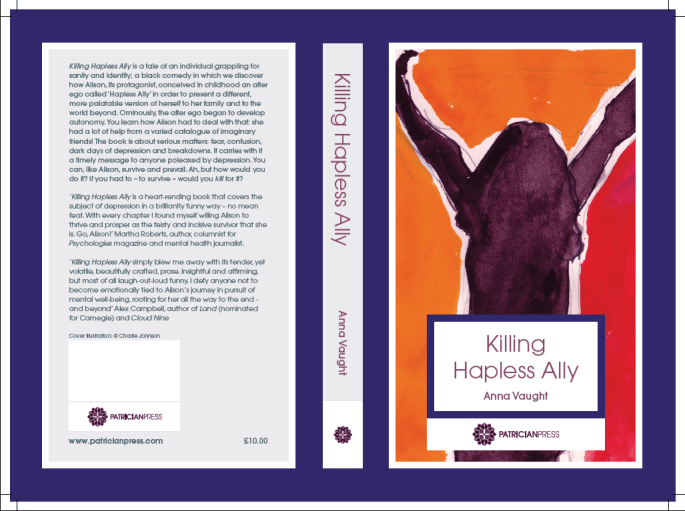
If you click on the link below, you can read a short sample of the book from Kindle Cloud at Amazon. I hope you go on to buy the book. Support your local bookseller, order it in – or find the book at Waterstones online or, indeed, on Amazon for both paperback and kindle copies. I am sure you already know this, but Amazon subscribers get the book for free. I’d love you to leave me a review, though (at either site or on my goodreads page) – and to be able to discuss the book with as many people and as wide a group of people as possible.
Anna.

I have so been enjoying listening to feedback from readers of Killing Hapless Ally. I know it is also being read for two local book groups, so if you fancy reading it for yours, I have added some suggested reading group questions, as given in an earlier post. The book is free on kindle to Amazon subscribers – although I must say that the paperback is a substantial, beautiful white and lilac thing with a striking cover by artist Charlie Johnson,
Here is the last review for the book, this one at http://www.goodreads.com this afternoon, followed by book group starters for you.
I received a signed copy of this book through Goodreads Giveaways – thank you very much – but this has not influenced my review.
Wow! This book is incredible.
I identified with Alison so quickly, I frightened myself. (Mind you, what sort of mother tells their child she was a mistake?) This novel felt like going through psychotherapy. Alison’s struggle out from the depths of depression is here written so beautifully, so intricately, so real. The streams of consciousness left me breathless and the letters written by Alison have inspired me. I am going to write my way through the depths and endure. I rejoice in Alison’s survival.
Questions for book groups.
Who is Alison and who is Hapless Ally? Are the same person or two separate people?
Would you describe Hapless Ally as real?
What is your opinion of Santa Maria?
Who is the most horrible person in the book and to whom do you warm most?
Did you guess the ending?
What’s the significance of the book’s title? Is it simple and straightforward, or something more complex and nuanced?
Did you like the names for people and places in the book?
Did you take offence to any of the descriptions – for example, of the f…… caravan, the funerals, dying?
There are many literary references shot through the narrative. Some are obvious and documented explicitly in the text (and thus you will see them on the acknowledgements page) but some are harder to spot. So get spotting!
Did you feel that you learned more about mental health from the book?
Did you think that the book gives us insights into therapeutic practice and the sort of help available (although I feel I must add, not routinely available) through our National Health Service in the UK?
Did the book help you? By which I mean, did it make you feel better about your own problems or state of mind? Did it give you a nudge to tackle things that are holding you back and making you unhappy?
Was the book shocking? If so, why?
Is it a happy ending? Is it over – in a good way?
Who was your favourite imaginary friend – and why? Dolly, Shirley, Albert, JK….
Did you feel sympathy for Santa Maria? For Dad? For Brother who Might as well be Dead? For Terry?
What do you think of Dixie Delicious?
What makes you laugh in the book? Is it the pickled egg murder/horrible deaths/caravan of evil/revenge on the tutus…?
What does the book show us about the power of literature and, more broadly, of the written word? What of the spoken – the “curses ringing”?
Why do you think there’s a shift in narrative from first to third person between the prologue and chapter one? Do you think it’s successful?
What’s the significance of the foreword to the rest of the book?
Is Alison strong, or is she weak?
Did all this really happen? Do you believe it did? Why?

Poetry is intensely valuable to me and it always has been. It is my antidote to despair, tiredness and loneliness; a thread that runs through my life. I solve problems with its lines—not just their lexicon, but the life breathed into form by rhythm, rhyme or meter: a riddle; a moment of joy. It is my borrowed voice.
A favourite is Louis MacNeice’s ‘Meeting Point‘, which I have always thought was a magisterial coming together of the ordinary and the the extraordinary; of quotidian rhythm and something magical. When I read this poem, I am caught up by its concept of the loved ones part of, yet isolated in happiness from the world; they are separate while they participate in daily activity. Something absorbing, supernatural and cosmic happens in the poem. And it is transporting.
So, if you feel sad or if you find anxiety about your daily life is skewing your experience of the beauty around you, anchoring yourself in a poem might help. Is there, beyond or daily our even bland experience, something extraordinary and connecting us to a myriad things? You’ll see that ‘God or whatever means the Good‘ is a phrase used. For you, faith may be about your place of worship; here the notion is broader. It is there, just not grasped; and so you might find something in this poem to cheer you and give you solace. It’s about the transformative power of love, too—its possibilities and the idea of time being suspended. I think we may feel this in love, but also in finding something that absorbs us, whatever that is. And that is truly valuable.
As for the structure of the poem: how might that make you feel better? I mean in any poem. The words lean on and support one another; they are interlocked in their sense and in their rhythm and this busy, subtle action draws forth, I might say, a music whose melody and beat speak to us and delight us. So read a poem aloud and test it on your pulse. What does it do to you? For me, the ‘time was away‘ refrain in the MacNeice poem of which I spoke, is comforting in its repetition, both of words but also of rhythm. You don’t need to know about metrical feet to hear this and feel it.
Here’s an idea. Learn the poem. Learn any poem. By heart. Then, when you feel your mood slump or you feel scared, pull it out and hear it in your head, mouth it quietly, or say it loudly and clearly.
It’s not that a poem is a talisman, but why not let it be an anchor? Every time you encounter it, you might see something new or notice you read it or say it slightly differently.
We are busy—so very busy nowadays; we are assailed by the images that tell us how flawed we are; a steady stream of information is constantly with us through digital media and I might argue that we have more, yet often we have less because we refuse to accept that difficulty and frustration are normal or to aim less for getting and achieving and more at being? It is not coincidence that we see a rise in the understanding and use of mindfulness techniques, as we aim to be stilled and in the moment.
But these are not new techniques, but refinements of much, much older ones and I think that reading a poem can be part of that. Why not be swept away by Porphyro’s extraordinary feast in Keats’s ‘The Eve of St Agnes‘? Find yourself utterly absorbed by epic simile and astonishing breadth of imagery and allusion in Milton’s ‘Paradise Lost‘? The middle English of Chaucer’s ‘The Canterbury Tales‘ is not as difficult as people may think to read and, in trying, a whole new world comes to a life. As it touches us, might we feel less alone in a world where we are often always ‘on’ and yet potentially more isolated?
Sometimes, we create in lines of poetry a little room – a world, even. For example, not long ago, I worked with a rather sad boy in the final year of GCSE. We tore up what we were doing and I watched his mood shift and his eyes go wide as we explored T.S. Eliot’s ‘Old Possum’s Book of Practical Cats‘. He became relaxed; lively—enjoying the characterisation and the jolly repetition.
I do believe—and studies bear this out—that we are seeing children and adolescents bowed down under stress from all angles and suffering more from mental health problems. Sometimes, I work with students who have had enough of schooling and see little hope for the future. I am not their counsellor, but I am happy to try and offer up some poetry to cheer them. It’s the rhyme and the rhythm that strike home. Like soothing stories for an older ear, no longer read to or quietened at bedtime by song or nursery rhyme. And an awareness, young or old, that poetry, as Dylan Thomas had it, ‘ is what in a poem makes you laugh, cry, prickle, be silent, makes your toe nails twinkle, makes you want to do this or that or nothing, makes you know that you are alone in the unknown world, that your bliss and suffering is forever shared and forever all your own.’
Poetry is always there; always important. For a challenge for us or a challenge to the status quo; to bring us joy or relaxation; it is that cordial handshake which brings with it words to surprise, delight and chronicle. It will always have its place and always be important. And maybe, as Shelley had it, poets are, after all, ‘the unacknowledged legislators of the world.’

I am about to establish a year’s worth of Killing Hapless Ally events, (while I am writing the next one, working title A Life of Almost) so just to say that there will be a couple of local and local (ish!) talks, hopefully a collaboration (musicians; other authors..) and also that if you have a book group not too far away (West Wilts, Bath and Bristol – South and West Wales even as I am often there), then if you order the books from the wonderful Mr B’s Bookshop in Bath, I hereby promise to turn up at your book group to answer questions if you would like – and will even bring cake! How about that? I was speaking last night to other authors about this as they have done some reading groups and found it a great thing to do. So let me know! If I am there, you can ask me anything about the book’s content – anything you like – and feel free to tell me its flaws!
And I had the best launch at Mr B’s Bookshop!

So tomorrow is the launch of Killing Hapless Ally and it occurred to me that, since we haven’t published book group questions and starting points at the back of the book, I’d do some here. You know, in case, wherever you are in the world, you belong to a book group and would like to tackle the book (as I know a couple of book groups local to me are already planning to do) – maybe with a few ideas to get you going?
Who is Alison and who is Hapless Ally? Are the same person or two separate people?
Would you describe Hapless Ally as real?
What is your opinion of Santa Maria?
Who is the most horrible person in the book and to whom do you warm most?
Did you guess the ending?
What’s the significance of the book’s title? Is it simple and straightforward, or something more complex and nuanced?
Did you like the names for people and places in the book?
Did you take offence to any of the descriptions – for example, of the f…… caravan, the funerals, dying?
There are many literary references shot through the narrative. Some are obvious and documented explicitly in the text (and thus you will see them on the acknowledgements page) but some are harder to spot. So get spotting!
Did you feel that you learned more about mental health from the book?
Did you think that the book gives us insights into therapeutic practice and the sort of help available (although I feel I must add, not routinely available) through our National Health Service in the UK?
Did the book help you? By which I mean, did it make you feel better about your own problems or state of mind? Did it give you a nudge to tackle things that are holding you back and making you unhappy?
Was the book shocking? If so, why?
Is it a happy ending? Is it over – in a good way?
Who was your favourite imaginary friend – and why? Dolly, Shirley, Albert, JK….
Did you feel sympathy for Santa Maria? For Dad? For Brother who Might as well be Dead? For Terry?
What do you think of Dixie Delicious?
What makes you laugh in the book? Is it the pickled egg murder/horrible deaths/caravan of evil/revenge on the tutus…?
What does the book show us about the power of literature and, more broadly, of the written word? What of the spoken – the “curses ringing”?
Why do you think there’s a shift in narrative from first to third person between the prologue and chapter one? Do you think it’s successful?
What’s the significance of the foreword to the rest of the book?
Is Alison strong, or is she weak?
Did all this really happen? Do you believe it did? Why?
https://www.writersandartists.co.uk/writers/advice/971/dedicated-genre-advice/writing-poetry/
So excited to have an article on this site!
This is today’s pre-publication review on Goodreads.
‘This was worth reading. It is a powerful book that gives you a peek behind the mask into a private struggle, a concealed personal experience of being someone who lives with overwhelming levels of shame and self-contempt. We use these terms a lot but in this case it is a military grade phenomenon with significant consequences. So what happens when some-one is really unwanted, really unloved and learns to assume that if some-one else knew them, they would hurt them, reject them. This is what Alison has to live with and this is her story. How she manages to survive and how when the real world becomes unbearable, there are other places to go with other people in them. It’s a demanding book, not an easy read and you have to concentrate, but it’s worth it. The content can be upsetting, the madness difficult to keep up with, but that’s the point. I’ve read loads of accounts of this kind of thing, but rarely is the author up to the task of telling a good story and keeping it up through the whole book. Anna Vaught, the author, is bold and honest. She respects the reader and doesn’t try to protect you so at times you have to put the book down and take a break, but not for long as it is a page turner and you want to know how it turns out. It’s not easy to live with this kind of stuff, the professional help has its limits and it’s a test, but you come away from the book with hope and a belief that although some people can be cruel, not everyone is and sustained kindness can really help.’
Killing Hapless Ally is out on Thursday with Patrician Press (link at content page to buy) in paperback; a new kindle edition has just been made available at Amazon.co.uk. The review above was written by a psychologist – an entirely wonderful person. At the moment, the book is in the hands of various health professionals, including a GP and a psychiatrist. It will be interesting to see what feedback the book has there. Yes – it is to entertain; but it is also to console and to give hope. x
 Anna Vaught Writes - Dr Anna Vaught: teacher, mentor, author, campaigner