I thought what follows might be informative, seeing some worried comments about and, also, the petition to enlarge GCSE texts selection (the wording for the petition ought to be more focused and informed – there is NO reading list for GCSE and you need to specify that the issue is with GCSE English Literature, I think).
Over twenty odd years, these are the ONLY GCSE English Literature GCSE prose and drama exam texts I have worked on with students.
Wuthering Heights (now on A level spec for a couple of boards)
Great Expectations
Anita and Me
Of Mice and Men
DNA
Blood Brothers
A View From the Bridge
Romeo and Juliet
An Inspector Calls
Jekyll and Hyde
Macbeth
Othello
The Woman in Black
These are the only exam GCSE texts I have ever done across schools, support teaching and tuition. Of Mice and Men and A View from the Bridge got booted off the GCSE specs by Gove (because they’re American) but it’s still there for me because I also teach IGCSE. In addition to these texts, across GCSE on the four boards I have worked across, Eduqas, WJEC, AQA and OCR plus Edexcel IGCSE, I have also to tackle poetry (which extends into the IGCSE Language syllabus too) where the situation in covering a wider and more representative range of authors is better (see below, for why) but even so…!
As I said, I have been teaching GCSE for twenty years and, until the situation with coursework changed and we went to full exam with the first teaching specs for 2015, you DID have more choice with the coursework texts as long as you satisfied the requirements. I am currently working with AQA, EDUQAS and Edexcel (IGCSE) and for all of these there is an additional poetry anthology, which does cover BAME authors to a small degree, but not a great range and I have been teaching ‘Search for my Tongue’ by Sujatta Bhatt for all those twenty years and John Agard’s ‘Half Caste’ for most of that time because there is a requirement to cover BAME authors in the poetry component, which was put in place twenty odd years ago. At that time a separate poetry and short story component by BAME authors was referred to as ‘Other Cultures’ (the word ‘Other’ tells you much, doesn’t it?) then the wording changed to ‘Different Cultures’, before the wording was dropped altogether and the texts included in the exam canon through a poetry anthology.
There is no ‘reading list’ for GCSE English Literature or English GCSE, but the shake-up that happened when coursework was removed and all GCSEs strengthened for first teaching 2015 was and remains inadequate and for GCSE English Literature, there is a too small selection of exam texts from which you can choose, with some variation across exam boards. If I were queen, I would make that selection of texts much, much wider because OF COURSE this is part of a much bigger issue of dearth of exposure to the brilliance of culture in this country, predicating what we do, instead, mostly on long-dead white folks.
That’s it. And OF COURSE I wrote to complain when the specs changed and it was the same old thing moreorless.
FOR ALLyou can email me on annavaughttuition@gmail.com or dm me on twitter as my butler will send me the messages. (I am away from social media!)
If you are working on a first short story collection or a novel, then I have a spot for free mentoring between September and January. This is for someone who is low income who could not otherwise access mentoring (and I will also annotate your work, suggest edits and proof). It could be for you if you are feeling stuck, unseen or perhaps you are sending out the work and it is not being accepted? If you are sad, bereaved, recovering or managing chronic mental and physical health problems. My darlings, I know first-hand what that is like and how hard it is. I am also happy to look at what you are sending your work out with – such as your agent pitch and covering letter. We will aim to talk twice a month as well as looking at your work. Please note: this is not for MG or YA work and PLEASE consider if it is appropriate for you. That is, you really will engage with what is said even though you don’t readily agree? You might not, at the moment, be in a place where you can do that. x
Are you a James Joyce fan and would you like a copy of my last book, Saving Lucia, to celebrate this year’s Bloomsday on 16th June? The book is partly about Lucia, Joyce’s daughter, but importantly it is hugely influenced by Joyce’s work. Largely Finnegan’s Wake, but it is also shot through with Ulysses. I’d be glad to buy someone a little present. https://www.foyles.co.uk/witem/fiction-poetry/saving-lucia,anna-vaught-9781910422564?term=saving+lucia
My next book, Famished, my first short story collection, is out with Influx Press this September, but you’ve got two fine books before me. Next up is Boy Parts by Eliza Clark https://www.influxpress.com/boy-parts and the press is selling this limited edition tote bag to celebrate its release. https://www.influxpress.com/shop/boy-parts-tote-bag Would you like one? Right. Well I am getting one for me, so I will get one for you too.
I thought I would jot down a few resources and ideas for you, if you have concerns about your secondary age and moving on (or trying to) teen. I am not a mental health professional, but my background is in secondary teaching plus tutoring and mentoring with young people, mental health advocacy and, with my own family, I have navigated various parts of the system and continue to do so; my older offspring are teenagers and life certainly has its complications for us at the moment! I have had various conversations with and messages from worried parents and friends over the past few weeks, so this is my response. Of course, I am thinking of the way in which education has been abrupted by Covid, but I hope there might be something here which could help at any time. It may also be applicable to younger ones. I went there too! Finally, services will be stretched and it’s a very busy time, understandably. Make sure you’ve got a cup of a tea and a decent biscuit if you’re going to be waiting on the phone for some time.
If you have been looking after a young person with mental health problems, google and see whether you have a local carers’ group to whom you could talk. I am a member of one. You need care for you as you do the caring. Also, please accept that it is very tiring to be a parent or carer in this capacity; give in to that. Try to take a break from things which rattle you (this is why I need to be away from social media at the moment; there are some ongoing things which damage my well-being in the face of additional demands at home and that’s no good), and, also, if you have other offspring, aim not to make the whole household revolve around the person or people who are struggling. Easier said than done, I know! And take each day in small increments, rather than looking ahead, dreading what mood is going to be like when the kraken awakes. You know! (Again, easier said than done.)
From my heart: if your child or your young person is in a hole, do your level best not to get in the hole with them. Which is to say that you care and you empathise, but you have also to look after you. That’s partly so that you can do a better job of caring, but also because you need and deserve that care, too.
If you are struggling with making comparisons – with families where there is a lot of support from extended family or whatever it is that you feel you do not and cannot have – I urge you to focus on what you DO have. Compare and despair. It serves no purpose other than to make you miserable.
CAMHS is Child and Adolescent Mental Health Services. Generally this is up to age 18 BUT in your area, there may be extended provision up to the age of 25, so google with your area and see what lies if you are really concerned about your offspring; ask your GP if you can get through! Moreover, while (I know this first hand) the CAMHS wait like the wait for adults is extensive and you would need to be referred by your GP, in some areas, there may be self-referral, which you do via an online form. This provision exists in our area. So, for example, we may have been unable to access ongoing CAMHS support in the end, BUT a psychologist rang us and we had a talk for an hour and she wrote me an extensive letter summarising what we had said and pointers for things to do. I am sure that there will be variation, but I can tell you that this is what happened in Wiltshire, for me.
Young Minds. It’s superb. Here. https://youngminds.org.uk/ There’s a stack of information about mental health and they have a dedicated section on Covid. There is information on a range of mental health problems, on what to do if you are really worried; that is, if it is an emergency or you judge it to be. There is information for you – with a dedicated parents’ helpline – and lots for your offspring to access for themselves. I have found them fantastic and, in the past, have booked an hour long session with one of their team. In its comprehensive information, there is explanation of CAMHS (see above), on hospital (for example, a blog entry by a young person on their experience) and a range of ways in which they can offer support. Do try. And remember it is for you as well as your young person. Young Minds looks after young people up to the age of 25.
MIND. Mind can support you, but they may also operate young people’s services in your area, where, for a suggested donation, a young person can access counselling. There will be a wait, of course; in the case of our family, it was six weeks – which seemed short and support is an hour a week, commuted to a phone call at the moment or a short check-in once a week if things are doing okay. https://www.mind.org.uk/ and here: https://www.mind.org.uk/information-support/helplines/ If you click on that, you will see an advisor bubble pop up. Tell them what you are looking for. Mind is now running a text service, too. For some people that might be preferable.
The Samaritans. You do not have to be suicidal to call. This is for you and them. Here: https://www.samaritans.org/ They now have a self care app which might go down well and also if it’s easier to write things down, you can email as well as call.
If your young person is unwell or has been unwell and intends to go to university this year or next, here is some information specific to that. Some of it I knew already with my background, but some I have learned because of what our family has been going through. If you are the parent of an offspring in year 13 and you are concerned about the impact of your young person’s mental health on their grade and can substantiate this, then you may not have been given the opportunity to cascade this information to your school or college exams’ officer in this current strange situation. In our case, we were advised to give statements and information/records directly to the chosen universities (general admissions team and, if you can, the admissions folk for the department your offspring would be studying under). This is so that the university understands that there have been extenuating circumstances. You would do this, perhaps, if your young one were to have been physically ill for an extended period and there is no shame in regarding their mental health in the same way. Your young person can collate information and send it (they are an adult) BUT a university can receive information from you as a parent or carer IF your name is listed as ‘proxy’ on their UCAS form. If your young person rings the UCAS central number, then asks for your name to be registered also on their form, it means the university is able to take into account something that you, as parent, have sent. We have just done this.
If your young one is going to university this year, make contact in advance and ask about their pastoral team and what is in place at the university or nearby in terms of support. Again, this is from the horse’s mouth. It means that something can, hopefully, be in place before term starts. You may well find that any paperwork amassed for point 8, above, does double duty here.
There are many, many more resources; more helplines; lots of fabulous people but I want to end this simply by saying that I wish you all the very best whether as young person or their parent or carer and I send you so much love. Anna xxxx
Some general thoughts. These may be used when you are first querying – that is, sending agents or indie presses your work – or perhaps they may comfort as you go further along and have found an agent or a publisher and…in comes the doubt. Or perhaps your agent has your book out on submission and back comes that creeping feeling of…what if/they don’t really like me/eeee this is tough/holy actual shit, am I good enough? Well then, you are going to tough this out. I absolutely promise you you are not the only one feeling this way and, if you thought you were super-amazing and considered yourself gifted PLUS the very thing that publishing needs, and that you know things no-one else does, then you’d be an arrogant twat and, ultimately, would you rather be that? I am sure you have seen the odd person like this on twitter – SCANDAL! NO? YES! – but it’s blather and hogwash because we are all ignorant and broken, however hard we try, so pah.
Anyway, here are some thoughts for when you are waiting, sad and slumping. Below them, I am going to add some specific tips about mental health – IN MY OPINION – and guarding it at specific times and in specific situations.
Back yourself. You may have felt crushed, had imposter syndrome (everyone does, I bet, unless they are super-arrogant and probably less talented than you: THAT’S MY THEORY AND I AM STICKING TO IT), compared yourself with others and beaten yourself up over that. Take a step back. Truly, what do you think? Have you forgotten to look after yourself and, self-reflection always at hand, of course, berated yourself and got in a knot? You must aim to think your work is worth it, whatever that means to you; measure success in your own terms: BACK YOURSELF – because that is where it all starts. Feeling knocked down because someone told you you were a bit difficult? Well, we’re not all going to get on and you cannot legislate for people’s reactions. Let that go once you’ve given it some thought and put it down. DID YOU PUT IT DOWN? Sometimes, the people who tell you you are difficult are the people you had no choice but to challenge and you’re not a weed so you did.
Play. If you are stuck, doodle, draw and just let your brain relax and, you never know, from there some ideas may emerge. Also, remember that this, and the thinking you do when you’re in a bubble bath, are also work and also part of the process. Don’t underestimate the value of imaginative freewheeling, either.
Inspiration not coming so you can’t write, huh? I think this is back to front: start writing and trust that inspiration may well follow from there. (Also, see point two.)
Try a different genre. Novelist? Try some flash or a narrative poem. It might work wonders. Example: this is what I did with short stories. I’d played around before but never thought, ‘Oh I will spend some good time on this now’ – until I did. WHOAH. I didn’t see that coming. Lightbulb moment. I wrote stories and felt more confident and, I think, that – the confidence and the discipline of short story writing – fed into my long-form work.
I’ve banged on about this before, but I know some people have a dedicated room of one’s own, or a special shed or an office. Well, I have written everything at the kitchen table with various offspring wandering in. I am writing this with the washing machine on next to me (no utility room, see) and a stew cooking; I can hear one of the cats going OW OW OW because it’s a bit senile and two of my kids are arguing and the other is in an absolutely foul temper. I am still writing this, though, aren’t I? I truly didn’t realise before that you just work with what you have. That was a revelation. I was waiting, I think, for perfect circumstances to evolve, but that’s deferring your happiness and your fulfilment in writing to fate, don’t you think? You could buy noise-cancelling headphones but here, if things get difficult, I just wear earplugs. I buy them in job lots.
Find your tribe. Online or in person. Can’t stress this enough. It doesn’t have to be a big old tribe; it might be very few people. But I promise they are out there.
Reading. All kinds. Indies and big publishers. A genre you have never tried. I read everything from Mills and Boon (I like the hospital settings) to early Medieval poetry and it’s great. I adore our indie presses, but I also don’t sniff at commercial fiction. If you’ve never read short stories or flash, then now’s a great time to start and PLEASE read books in translations, by people from all walks of life, from lots of writers of colour, fiction and non-fiction. In other words, improve your diet.
Remember to be amazed. Inspiration and ideas will strike or you will see something, quite by chance, that lights a fire and prompts some writing. I PROMISE YOU.
Never forget that your first draft of something is going to be shit. It’s your shit first draft.
Get out into the world by whatever routes you can. I mean, online if it’s not possible in person. Diversify your reading, as I said, but also curate some things on YouTube and choose some wonderful podcasts to listen to. There is so much stimulation to be found and, if you are stuck, had the misfortune to work with someone who has turned being wanky into an art (it happens; be patient), have hit a slump or you are repeatedly having your work rejected, kick back just a little and find some time to tune in. How about that?
Now some specifics for what to do to look after your mental health at specific points. I need to say, I think, that I do have specific mental health challenges. Telling you this may, I hope, help what I write here to be a little more resonant and make a little more sense.
Querying – when you are first sending work to agents and small pubishers (presses) – and a side note: some quite big publishers DO, still, accept unsolicted manuscripts. (Serpent’s Tail, for example.)
Compare and despair. This MIGHT mean you have to get off social media, or just do some hefty curating (through your settings, mute accounts, but also words and phrases). You have sent out a partial and you wait and you get rejected or wait and no reply (which happens a lot even with those who say they WILL reply, sometimes). During those times, others will get picked up and celebrate. Celebrate with them; that the best way. It’s generous and, frankly, better for you, too. Yes I know you see ‘hotly contested’ and ‘six figure deal’ but you cannot control that. Focus on you. A lot is also not what you think. Overnight success is rarely that! Also, life is not fair and it is not exactly a meritocracy out there.
Be working on something else. Always. It makes you feel productive, it’s professional and it’s a feeling of productive and good energy, if that’s not too woo for you. If you are starting to feel shaky, pouring yourself into something else can be wonderfully good for you. This is my opinion; also consider whether you need just need to take yourself off for a while.
Note the tribe in the general pointers above. Tell those people how you are feeling if you feel exposed or vulnerable.
Focus on your reading. It’s your best teacher. See also the general list above for thoughts on expanding that reading.
This is competitive and tough. You have (forgive me) to be prepared to work your tits off. There is no way round it. Rejection is hard-wired into every stage of the process. Get used to it. Okay, that sounded too hard? Weeeeell now; think of it another way. This is training. You are learning about waiting, and passion and rejection and you are still doing it. This is GOOD. You are on your way. Also, really try to reflect on the fact that it takes courage to send your work out in the first place and you did it. That’s pretty amazing, if you ask me.
THE OTHER SIDE? Looking after yourself when you have work coming out, out or maybe a book out on submission from your agent to editors at publishing houses. I am going to roll into this the idea of what to do if things are going wrong. That is, you are not being treated kindly. I don’t mean to make the industry sound brutal…but…brutal things do happen. To your self-worth, to your belief in your work and – I talk to A LOT – of people, if your published work is not looked after, it will hurt because this was your dream, right? If someone is rude to you, tells you you’re lucky to get published in the first place, won’t have dialogue, listen to you or prepare you in any way which shows that they value you and your work, then it is frustrating, sad and painful. But there are things you can do because you’re tough and resourceful. Read on.
1. I know I blathered on about it above, but once you are published – a first book or collection – you are still likely to get rejected. Some people have an easier time than others in this respect, but you cannot legislate for that so onward. I think, though, it helps to be prepared. What forms could rejection take? Foreign and translation rights don’t sell, readers hate your book (call a spade a spade!), the timing is bad for some reason, it doesn’t get reviewed. Also, you may write a second book for the same publisher and they don’t want to publish it or, in fact, decline further work from you. All of these things hurt, but this is why you are working on more and maybe diverse things. Allow yourself to be upset, but then burrow into the work. Also, tell your tribe! If it triggering and you actually feel unwell, it’s time to take a break, unplug from publishing and writing news and read! You WILL recover.
2. What if you are treated badly or misrepresented and it makes you feel vulnerable? Tell your tribe and, if it’s really bad, it’s an idea to have a conversation with The Society of Authors and do please work on your self respect. In any line of work, there could be bullies, and raving egotists and gaslighters. There will, I am afraid, be people who are publicly feted and congratulated for how wonderful and generous they are, but you KNOW they have been belittling and demeaning to you. The bottom line is that this irks, but spend half an hour talking to experienced writers, and see you are not alone. Knowing you are not makes you feel stronger and also, frankly, better to be you than an epic duplicitous twat who on some level knows they’re duplicitous. That’s not nice for them, either.
3. Going out to be a more public person. This is potentially part of the deal, right? Well, you can choose whether to read your reviews and actually, you get told not to look on Amazon or Goodreads, but if you do, some of them are gold. I mean, one of mine said I was clearly the sort of woman who wore a pashmina. I am trying to say, guard yourself, don’t look, don’t take it personally but also have a sense of humour. If you are very anxious about being more public by having a book out and then, perhaps, doing events, tell your agent and your publishers – the publicist, editor (take advice at the time on who’s the best person to have a chat with). I don’t want to share confidences I have had with my own agent, but I have had to be honest not only about my own challenges – some of which were made temporarily worse by a few tricky events since I got started in writing five or so years ago – but also about the level of significant challenge involved in being mum to young people with additional needs. I have been entirely upfront about my complex history and explained what the current situation is. Snowflake? Too confessional? RUBBISH. This is called being trusting and I want you to regard it as part of a professional relationship. I hope you find this encouraging. Think details, too. Tell someone if you think you might panic at an event. You might not, but be prepared and have a written plan B. A list. I LOVE a list.
4. Learn to wait and that there will be periods when you are between books, or are starting a new book after one tanked, or didn’t get placed, or the editing is taking longer than everyone thought, or you have a book on submission and are a bit nervous. To everything there is a season and there will be fallow periods; there will be times of feeling rootless. A suggestion: try writing something different for a while, just for fun. In an entirely different genre. It may be that something amazing comes of it.
5. I have said compare and despair before. Yes, at the initial querying stage, but also once you are published. No two people have the same experience as far as I can see and, anyway, you cannot see all of it. Each time in publishing will be new and different because of a combination of interpersonal factors, timing, all sorts. People in your publishing house will be way more successful than you (well not everyone, obviously), but even then, you don’t know what those guys worry about. Focus on you and your work, your route. Don’t expend precious energy on this or you will end up feeling persecuted too.
I hope this lot helps. Write and tell me if you like.
First of all, it’s really important to state that there is nothing good about the present situation, though I have seen many acts of extraordinary goodness through it. I hope that you have been able to see such things, too. I cry most days because we are all aware what people are going through and how many are grieving. It feels intolerable, doesn’t it? I have strong views on what our government has failed to do and what Trump has enacted in the US – our family is Anglo-American and we worry so. I worry about how people are and how they will be. I am sure we all do. But, still, this piece is about what I have reflected on during this period – and reflected on for us, as family. As I write I am recovering after many, many weeks, from pneumonia. GP thinks it may be a secondary infection after Covid, but we don’t know for sure. It has been a time. I am high risk anyway, so have to continue to isolate.
Anyway, here we go. Ned (husband) and I have both worked at home. He turned our bedroom into an office; I am doing Skype teaching, rewriting another book, editing, getting my new book out and preparing for another one being published in the autumn. Lines are busy at at all times. Most days it has been chaos. One some days I have muddled appointments and the kids’ music stuff or the doctor ringing. But some thoughts. Before those thoughts, let me tell you that I would rather stick pins in my eyes than sound smug or rather be misconstrued as smug. Please forgive me if, at any point, I have the tone wrong. x
I am more grateful than I have ever been in my life that I have a home. To the point that I have sat on the stairs and thought, I HAVE STAIRS and wept and I was weeping partly because I knew other people did not have a home.
There is, for us, some strenuous work here. We are both now self-employed for a start, but we also have three offspring at home and they have had to learn to muck in a lot more. It’s hit and miss, but there has been the odd moment of pure help-joy (I just made that up): our youngest, who’s just turned nine, was out in the garden at six thirty, sorting out the chickens and pegging the laundry out with a huge grin on his face when he saw me notice. That is a moment I will always remember.
Ned and I decided that we wanted, as far as was possible, to make this time feel safe and cosy and, if possible, for the kids to derive good memories from it. That would mean letting some things go and some things slip. Sometimes we have been stressed and shouty. Last night we had an awful row and the neighbours in the terrace were ear-wigging and pretending not to. It was over some stupid thing like I thought he said something in an off sort of tone and it escalated just like that. Me, not him. Overreaction owing to ongoing stress and feeling knackered. BUT what I want to say is that we have tried, notwithstanding intermittent failure, to keep it cosy by being a bit slovenly. I have done some home learning but not a lot with the youngest; partly time, but partly because I could see he was tensing up. There has been a lot of telly and I am pretty sure crisp eating occurring at breakfast. But I have turned a blind eye to the crisp eating and decided not to push it. How people with more than one young school age child and a home learning roster have coped, I cannot imagine. My older ones have been moreorless free-range within the home. I am sure this horrifies some local parents.
We began this period with one exam year offspring out of school long-term with ill health and little or no back-up. It would be inappropriate to detail what happened and what is ongoing, but lock-down means I cannot be helped along as I was by my carers’ support folks and ongoing work for offspring has to continue by phone. There have been some very dark days. Another exam year offspring is SEN and has been badly failed. I feel like I have been battling for absolutely years for the two of them. I would do it again in a heartbeat but, suddenly, the battles had to stop because school suddenly stopped and, aside from admin and new directions, there is nothing I can do. Sometimes it is freeing to know that there is nothing to do. I am all action bias, me. I want to be doing and sorting. I cannot. I appreciate teachers and schools very much; it’s my background too and I love it. But school for my older ones has often been a shitstorm. I had a period of intense anger and grief – at least I think that’s what it was – shortly before lock-down and shortly after it began and allowed myself to feel it fully because these are my kids and time and again I have found myself tacitly blamed for failures in their educational provision. Anyone who’s battled knows how exhausting it is and how you question yourself to a point which is not healthy. Suddenly, it’s over. About the road ahead, in different places, well…can’t worry about that because don’t we know yet that today is all we have? The past is a different country and the future is up ahead, where we cannot ever BE.
Related to those last lines, I have found this has been a seminal lesson in living in the present. We are all scared to some extent. (Clearly some are more insulated than others from the stresses of it all.) We are all mortal and vulnerable. It is well to look about us and appreciate being alive and that we have the capacity to love and be loved.
I am not neurotypical. My brain is bamboozled by a lot of social activity; I have triggers in many situations and suffer from dissociative episodes. I find some situations very hard to deal with and the school run brings me out in hives. I have never, ever liked parties. This does not mean I don’t enjoy other people. I adore them. I am also still – STILL – shit at self acceptance, with the result that I worry about being like this. I love being on my own; I need to be on my own and I’d be really happy if I hibernated for a bit and only saw the postman and had a chat with him or her. Do I love my extended family, friends and people in general? YES. But I start to feel poorly and stressed with a lot of social contact or (it’s all coming out now) certain types of social contact where there is unspoken conflict, oneupmanship and the like. That happens, for example, in parenting situations and it lowers my mood. I know I am not the only parent to feel this way because I have compared notes; sometimes people telling me things weepily in a torrent that were a snap with mine. During this period, I have had a chance – not because of lots of time but because the lack of certain troubling social situations pressed upon me – to reflect upon my need to focus more on certain situations and less on others and to stop ignoring what are very real psychological needs. And however lovely the participants, I am never, ever, joining a whatsapp group again. My brain cannot cope!
You know, I was going to do 10 points.
I could have stopped at 6 because 6 is an even number and, ever since I was tiny and could understand them, odd numbers have unsettled me a little bit when I see them on a page.
But 6 seemed a strange place to stop.
So here. 10. That’s good. Phew. 10 asks you to take as much care of yourself as you can and also, please know – I am saying this to myself but maybe it could comfort you; that would be the best – that weird is good, that you should come as you are and that the sunshine on your back, the smile of a kid who knew you’d be pleased (needn’t be your kid; needn’t be a kid at all, really) and the moment the apple blossom opens are the most precious and decisive moments of your life. They are small, but fancy stuff, big plans – they are infinitesimally unimportant, after all.
I knew, before Saving Lucia came out, that much of the focus would be on what happened to the women of the book at the hands of men, or the way in which female identity was othered or policed by men. It is clearly a theme of the book. But there is more to say on the topic, some of which I have already raised in other articles. I have to be careful in what I say – who was responsible; which women, too – because there are real people in these books, with real relations still living, some of whom have got in touch with me (this has been one of the nicest things that has ever happened to me, by the way). So my point is to look at two things. One, the subtleties of two male characters in the book and the second, the role of the family. As I am pressed for time as I write, I am just going to refer to Violet and Lucia; later I will write a more expansive piece and look at all the women. I am also going to thread through some personal detail.
Dr Griffith, the fictional doctor in charge of St Andrew’s (a real place and still going, if you were unaware of this), is a doubting Thomas. He does his job as best he can, but he is reflective and, increasingly unsure of himself. There is something in Lady Gibson’s devotions, meditations, wit and confidence which unsettle him. He vocalises this in the book. She speaks of memory and art; of imagination and literature and seems to see, in past and future, something which, to him, is at best inchoate. But rather than bluster, he admits doubt. I think doubt is both a function of intellect and compassion. I based Griffith on my own psychiatrist, run off his feet, unsure what to do with me, as I was both simultaneously very ill and functional; as I told him what the inside of my head looked like (a little bit like Saving Lucia, as it happens) and said that I’d managed thus far, that he looked tired, had he eaten lunch and that there were people who needed him more. He took off his glasses and rubbed his eyes. ‘Oh Good Lord. We do not talk about deserving, only about need.’ And we went on to talk about doubt, uncertainty, the things that hadn’t worked and, frankly that no, he hadn’t had lunch. He also asked me my opinion and told me that he was hesitant to do certain things and wanted to reassess others. I loved him. Because he admitted doubt. Griffith, in Saving Lucia, is kind. He is also unsure, now, of his vocation, his daily role and his past; he meditates on his past, stimulated by Violet; he thinks about being Welsh and his passivity in the face of being Anglicised by his father and, also, he thinks with a gentle sorrow about his days of learning scripture and being a church boy because he can see that faith is integral to how Violet sees the world; that the force of her nature and what sustains her seem to be predicated upon it.
As for Lucia, history shows us that no-one was an angel here, but I tried to be careful in the book and look at the role of sibling and mother. It is Violet who brings up the notion of Lucia being ‘rubbed out.’ She says to Lucia, ‘It is not right what they have done. They made you not exist, out there.’ Violet is referring to Lucia’s nephew, the late, controversial and highly litigious keeper of the Joyce estate, who was responsible for the destruction of letters, documents and records pertaining to Lucia. Hence, partly, Violet’s idea of ‘Saving Lucia’. Yes, pointing her towards freedom, but also being recorded as someone remarkable. I believe that she was. Lucia is haughtily disrespectful to her mother, rude about her brother and others and, though we see love when she speaks of a father, it is to the family that we return – that all she wants is for the parents to say, ‘You are my child and I am sorry. I am sorry.’ This was the most difficult part of the book for me to write because it draws on my personal history. It is something I wanted but could never have; I felt I had to endure its hurts again and again in hearing my parents praised as they were, until I let go. I didn’t need to forgive; I just needed to go on. Then, I was lighter. (It took a long time for the NHS to get me to this stage.) And you have to remember that if someone’s parents were not fit for purpose, they may still have deftly and meaningfully touched the lives of others. We are not one thing, as human beings – just as Saving Lucia is not only the story of men shaping the course of women’s lives. And I am shifting any binary structure in the book, anyway: reality and dreams; gender and sexuality; complicity and innocence. Life is so much more nuanced, isn’t it? That’s why Lucia asks you to remember the ‘generous ambiguity’ of what you think you know; of madness, of sanity and of life.
Lucia’s mother did not visit her at St Andrew’s ; before her committal there, Lucia was rather left behind in a French sanatorium and, when James Joyce died, she heard it on the radio, only being brought to England at the behest of a family friend. I spent a long time imagining how that time – cut off from family and listening to the radio to hear of her bereavement so impersonally – might have been and I hope I can say that, while what has happened to me is not a tenth of what she must have endured, I do have the faintest notion of it all. But when she was there, alone, there was a whole family elsewhere – not a repression by one man. I want to set that down. Think, also, of Lucia’s mention of Dr Delmas – a real doctor – in France before and during the war. She wants to know more about him; to find him perhaps and question how he kept people safe. There’s a man as protector, just as there’s a man in charge of St Andrew’s who’s made kinder and more indulgent because he has the capacity to self-reflect and to admit doubt. I am thinking about this now. There is much to say about the patriarchy, then and now, but it has been a woman – with an acquiescent man – who has wrought the most havoc in my life; while it does not colour my view of history beyond my own, it is partly this which prompts me also to lift up examples and make my own book be seen its more subtle depictions of gender and what that might mean – in all its troubling and plural forms.
Sometimes, you write something for something – maybe as a single piece or part of a collection: it stalls and needs to be put down. That might be a poem, a story or even a whole book. Below is a story which we decided didn’t quite make the cut or fit for a collection , so I thought I’d offer it to you now. At this point, it was still being edited. It’s as mad as tits. I quite like it, though. Anyway, nothing is wasted. Have faith.
This story is about potatoes, sex, a kind of witchery and heated greenhouses.
Nightshade
‘Will your lordship please to taste a fine Potato?
T’will advance your withered state.
Fill your Honour full of most noble itches
And make Jack dance in your Lordship’s breeches.’
John Fletcher, The Loyal Subject, iii, v, 1617
It may be that you have never looked properly at the common potato, but the fault lies with you. No potato has ever been common, for it has a rich and delicious history dripping in lard, butter, spice with a finesse of debauchery. That is its nature. It is many things. And if you think the potato’s only role is to be mashed to smithereens, chipped, or, if you are the sort to go out for supper parties, misrepresented in dainty coils and piped, then you ought to read on. This is not a cautionary tale, but I will say that you ought to beware the potato because it is also a nightshade and may contain venom And best, also, not to assume certain things about it or the person who tends it. Or he who has the temerity to say he knows it best! Come wade through victuals and skate upon a dauphinoise with me.
My name is Belladonna, my middle name is Atropa and I like hasselbacks, the smell of earth and extraordinary strength and fervour. I like woodcutters and potency, sex and a fine table of celebration. I like bold funerals, colour and fire and run to satisfy cravings for green and purple berrie, the fruits of my kind.
I was once married to Earl Julius Clopton. I did my best by him, but had to assuage myself with extracurricular passions. Nights with him were cold and mechanical and he had the ardour of a soft, sad dish of cold whipped potato, made by a nanny who had never been hot or happy. I tolerated it until I could no more. If it had not been his fault, that would have been one thing. But it was his fault. He could not be tempted, would not deviate. There must be legions of these sprauncy fellows, ignorant and burying alive their glorious wives – delicious women who are crushed and miserable, eyeing fine sweet bacon but forced to live with their gammon husbands. It makes me shudder even now.
But as I was saying. The potato, yes. It was a subject awaiting an author. The potato has had a long and colourful life. A member of the botanical family, Solanaceae, a cult of flowering plants that ranges from annual and perennial herbs to vines, lianas, epiphytes, shrubs, and trees. It includes agricultural crops, medicinal plants, spices, weeds, and ornamentals. Atropa belladonna, commonly known as belladonna or deadly nightshade, is a perennial herbaceous plant in the nightshade family, which includes tomatoes, potatoes, and the bold and shiny aubergine. It is native to Europe, North Africa, and Western Asia. Its distribution extends from our England to the Ukraine and the Iranian province of Gilan (I may have had husbands in both those places) in the east. It is naturalised or was introduced in parts of Canada and America. Some claim that all of the plants, like creatures in a cult, are damaging. This is because they have never met Atropa Belladonna.
I know best how to handle the Solanaceae. This is my family. I know that the foliage and berries are extremely toxic when ingested, for they contain tropane alkaloids. These toxins include atropine, scopolamine and hyoscyamine, causing delirium and hallucinations, and are also used as pharmaceutical anticholinergics. These tropane alkaloids appear to be common in the family Solanaceae, as they are also present in plants of the genera Brugmansia, Datura and Hyoscyamus, of the same family but in different subfamilies and tribes than the nightshade. Ah, I am botanist and chemist as well as epicure and lover. I have a large family and an obscene number of cousins.
We are bold, bold things. People are often scared of such boldness – of passion and impropriety.
More fool them. Atropa belladonna has unpredictable effects and so does Belladonna Atropa. The antidote for belladonna poisoning is physostigmine or pilocarpine, the same as for atropine. The antidote to me? I am cunning, so you must be vigilant but after that, though you may retch with the poison, I am invariably fatal.
The potato. What a colourful family it has! What you may think of as the common and grubby English tuber, was, to our ancestors, in fact the sweet potato: patatas, not potatoes, nightshade to your convolvulus, your – forgive me – morning glory, and it was not until quite late in the potato quaffing that the English variety replaced the Spanish Ipomoea batatas, for our stolid lot were growing to love the Solanum Tuberosum that is such a bedrock of the gustatory experience across England And into it came a man, a most remarkable author. He became one of my husbands, whose name was Earl Julius Clopton. At first a doctor, his tuberculosis halted his work as Director of the Pathological Institute at the London Hospital in 1904, and he would then spend six months in a Swiss sanitorium It took him over two years to fully recover from the illness, changing the course of his entire life. Rumour has it that his strength was gradually renewed by dishes of creamy, sieved mashed potatoes. Baby’s food. That fitted him. He purchased a house in Barley, Hertfordshire and, because he could not return to practising medicine, began experimenting in the emerging science of genetics under the guidance of his friend William Bateson. After several failed experiments with guinea pigs, Monarch butterflies and hairless mice, Earl Julius Clopton decided to experiment with potatoes after seeking advice from his gardener, a man called Evan Jones, a salty and rough handed genius from Carmarthen whom I enjoyed many times and came to admire greatly.
Evan Jones was one of those geniuses whose work is usurped by posh folk, but I held him as he wept about that, and he held me as I wept over his trugs and piles of hoes, mostly facing forward but sometimes held aloft because as well as being a potato expert, Evan Jones was a man of prodigious strength and appetite. He’d be pricking out seedlings, or pruning and by God, within minutes there was thunder and that man could be thunder anywhere It pained me, appreciating his prodigality as I did, that he had been humiliated by his master in this way.
Later in his career, commenting loudly on his decision to study potatoes Earl Julius Clopton my then husband noted that he had, ‘embarked on an enterprise which, after forty years, leaves more questions unsolved than were thought at that time to exist. Whether it was mere luck, or whether the potato and I were destined for life partnership, I do not know, but from that moment my course was set, and I became ever more involved in problems associated directly or indirectly with a plant with which I had no particular affinity, gustatory or romantic.’
I was at a party at one of the country houses of his horrid and temperate acquaintances when I heard him say this. I often went to parties at country houses; the women I am sure thought I was once a whore, whom he had, by his grace, dignified; I had more class and elan than the gentry and was definitely lither of limb and of more prodigious imagination in bed.
Earl Julius Clopton was guffawing his potato speech to the assembled company and, while it hurt me to hear him say that he had felt no affinity, gustatory or romantic, with the potato plant, I had thought that at least he possessed some imagination and would come on in time because he looked sturdy enough. When first I had that thought, that he might do, I had made a play for him and of course succeeded, sweet poison and all and, in time, came to have exquisite rooms in his mansion in Hertfordshire. I had been wrong. He was cold and mechanical and barely bit me or looked me in the eye.
Then that eye went roving. The fine home was comfortable enough, the grounds were lovely and that was where my sweet leaves brushed against Evan Jones. There were lively times in the potting shed and hothouses as you have heard, it was close to London for the stews, court and the theatre and I was happy there. But oh, my horrid husband!
For here was the thing. Earl Julius Clopton learned from Evan Jones but took all the glory and Evan Jones was angry. That made me angry. My husband’s book, On the Common Potato was lauded as a noble work in The Spectator and a work of the most extraordinary scholarship by The Times. On another occasion, I heard him downstairs talking to friends, peers, old duffers from the House of Lords; Evan Jones heard them too because he had shimmied up the drainpipe and clawed his way in to visit me mightily in my parlour and there we lay. My husband was in his cups and chortling, ‘No-one knows as much as I do! I know more about the potato than any man living!’ I saw Evan Jones set his jaw and snarl; my own eyes were wide. My husband didn’t appreciate the potatoes. What did he know anyway? I had looked at drafts at his magnum opus – his spelling was not so fine for a titled Cambridge man, and with a doctorate too – and he had even failed to note that in the Renaissance, patatas meant sweet potatoes to many. They had come from Spain and oh, roasted in ashes, a delight of sweetmeat and do you know that some thought them similar to marzipan, only yet more delightful. Marzipan is a lovely thing to think about when you are in flagrante delicto.
In the book you would think he was an expert on all things, but the discrepancy here was only solved thanks to my perspicacity. I was perspicacious even when I was in a hurry, and even a I smelled woodsmoke from the parterre and knew that Evan Jones had the hothouse stove stoked up to sultry and was waiting for me by the pineapples.
I digress.
There were melons there too. In that wonderful hothouse. And avocadoes. And that – the paucity of scholarship here and there not the hothouse delight – wasn’t the only thing.
k….Earl Julius Clopton was unaware of the true glory of the potato and, while he alluded to its role as an aphrodisiac, he did not ingest them in that way. His book was marvellous on the potato story, I’ll give him that; he’d traced the tuber’s roots to the Andes and explained that it was of vital significance to the Incas, the fatal plantings, blight, a mythical connection with Virginia and confusion between the sweet potato, the Jerusalem artichoke and, would you believe, the truffle. But he would say all that, because he’d been tipped off by Evan Jones of Carmarthen. He was comprehensive enough on the link between luxury – which the potato was for the Tudor gentry – and sexual congress, but on the aphrodisiacal qualities he lacked warmth and insight. I have been laughed at for suggesting that the humble potato is one of the greatest antecedents to powerful sexual congress, but I am correct. As I am correct on tomatoes and aubergines. Love apples it is true and, don’t you know, applying aubergine juice to yourself as directed by the Kama Sutra is very effectiveand I could show you some very saucy haiku about aubergines if you are passing over my divan sometime.
My then husband’s noble study was published to great esteem and earls, viceroys and baronets, effete potato fiddlers all, came to our Hertfordshire home. I was in attendance then, though yearning for Evan Jones who had a secret sunken hot Turkish bath project on just for me, lurking behind the composters in areas where my husband never deigned to walk.
Working with the servants, I gave out witty little dishes of whipped potato with commemorative spoons; I was a courteous wife. There were crisp and soft potato croquettes and little amusements of scalloped potato and chipped fripperies no wider than a baby’s finger. And the guests brayed and congratulated their host. Later they sat down to a full potato-rich dinner and that, you see, is when our plan began to swing into action as we busied ourselves crushing berries. Because he’d missed it all you see. That is wrong to steal and covet the work and life’s knowledge of another man, that self-congratulation and uppity ways are appalling and may warrant drowning in a bowl of Vichyssoise. There is nothing quite as revolting to a woman of my hot temper as disappointed concupiscence; of fervour met with a tallow face and a very poor quality of aubergine.
As I told you, my name is Belladonna, my middle name is Atropa and I like hasselbacks, the smell of earth and extraordinary strength and fervour. I like woodcutters and potency, sex and a fine table of celebration. I also like bold funerals, colour and fire and run to satisfy cravings for the green and purple berries of my kind. My husband had never even noticed my name: it means Deadly Nightshade and I daresay he just thought it was pretty, if a little whoreish. Evan Jones knew of course. A beautiful thing that could kill you. So that night, after our aubergine ritual and dishes of roasted tomatoes with the hot spices he grew just for me, I added something special to my current husband’s nightcap; the results of the crushing. The maid was in on it; they always are. And we put the green and black berries of the nightshade in the juice, and that was it. I thought of many things more theatrical –drowning in a barrel of potato potage or tying him to the behead and forcing him to feast on potato eyes until he expired. I even thought of chopping him and putting him in a pie, with an unctuous gravy made from his viscera.
But I am not a savage. Perhaps he choked a bit, but mostly he didn’t wake up and I played the widow. To my delicious shame, Evan Jones from Carmarthen later cut me out of my funeral weeds with his best secateurs and there had been another bold funeral. Soon, in a blackish ceremony, Evan Jones became my new husband. Oh, he was a hot man. But you missed the woodcutter clue perhaps? Ah. Harold Ebsen from Deptford came to maintain the estate’s woods and with him I found such delectation and he was fond of my whoring and knew more about the wild plants of the hedge and woodland than Evan Jones. Harold was a man more of the shade than Evan Jones of Carmarthen, who was ruddy-faced and of the sun, like a heliotrope, or a Jerusalem artichoke, Helianthus tuberosus. I have never found one man to be adequate. Have you? ‘Ah,’ I sing to my bosky young lover, ‘come, sweet boy. Wade through some victuals and skate on a dauphinoise with me. My name is Belladonna, my middle name is Atropa and I like hasselbacks, the smell of earth and extraordinary strength and fervour.’
There have been a number of comments about men being the suppressors of women in the book, but what about Dr Griffiths at St Andrew’s or Dr Delmas, whom Lucia repeatedly mentions? What about Lucia’s mother or other female – or male – characters in the book? Also, Augustine is dressed as a man. Why?
What did you think about the way that Violet and Lucia spoke?
As it asks in the book, ‘Did any of this really happen?’ Could it have? Aside from the facts!
Why is imagination so important in the book?
Did you believe that Lucia Joyce left St Andrew’s (if you didn’t know the facts of the story)?
What picture of families does the book paint, do you think?
Who did you think was most mad?
Why does Violet do what she does in giving voice to Blanche and Violet and asking Lucia to be her scribe in her last days?
What links would you personally make between the lives and treatment of the four women in the book and attitudes surrounding mental health problems and mental illness today?
What did you like most about the book and what least?
Did you recognize lines from works of literature woven in – lots of Joyce and some Beckett, but lots of others too?
Did the book make you feel hopeful – or perhaps sad?
If you are reading the book during lockdown, did you find anything in it to sustain you? For example, Violet’s idea that ‘those who are confined have the best imaginations’?
Did you have any thoughts on the depiction of Violet’s religious faith?
In what way is Lucia, ‘saved’?
Do we have the right to retell – even as historical fiction – others’ stories, especially when those people have had their stories partly or fully hidden or silenced?
Did you think Saving Lucia was funny?
Why was Bertha Pappenheim – Anna O – included? She is not incarcerated like the other three women.
Who was your favourite character and why?
Feel free to let me know your answers if you would like to share them.
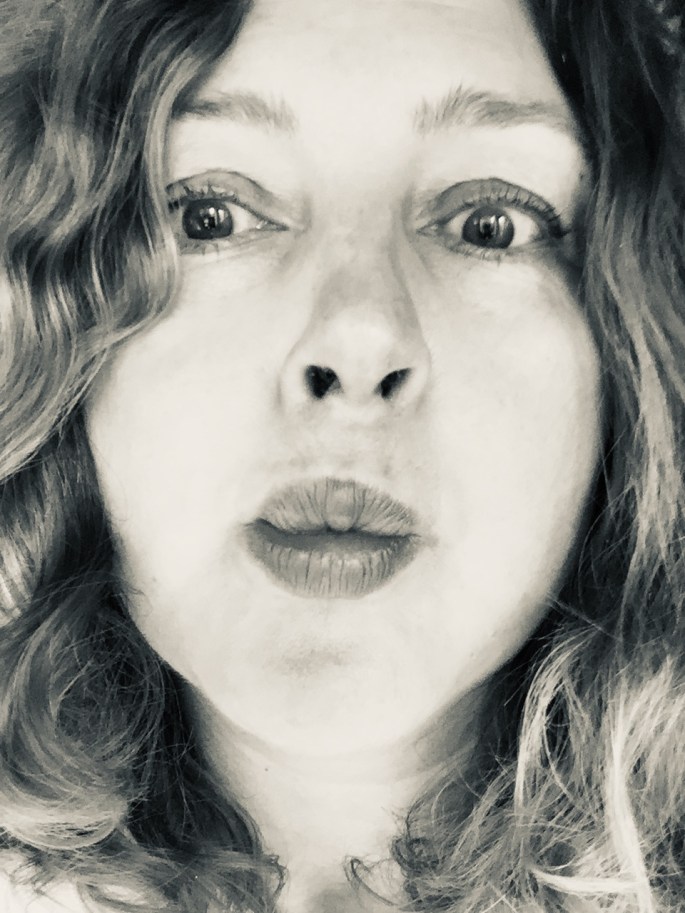
Hello. How are you. I am sorry for what we are going through and send you love and strength. Also, a kiss, as in this embarrassing image, above.
Here is a brief newsletter from me.
I am due to have a new book out, Saving Lucia, in two weeks. I have waited for this – as you generally do – for two years but the publisher, Bluemoose, has now announced that, as of yesterday, the forthcoming seventy two hours will show them whether they are going to survive as a small press. You can imagine how that feels. I am sad for them and hope they make it through; maybe I won’t know until the last moment what will happen with my new book, so I am not entirely sure what to do now apart from wait. You may be feeling like this, too. Lots of people are. However, books are, and always have been, at the centre of my life so I suppose I see this book, Saving Lucia, as having a life wherever that might be. Hopefully where it was intended, but it looks like that is uncertain. I’ve been reflecting that the book didn’t exist and now it does and that, in itself, is an achievement and a source of joy. In itself thinking like this is also a business decision – because knowing that it has brought early readers joy makes me determined to see it succeed.
Coming up, whatever happens, I have a q&a about Saving Lucia with my dear friend, the author Lucie McKnight Hardy on the 30th of April, a blast of blogger reviews, articles I’ve written for 3A:M, Severine and and Isobel Costello’s Literary sofa; an interview with Minor Lits. I have spoken at the Stay at Home Festival about Saving Lucia, trauma, memory and the imagination and next week you will be able to see me at the Bookbound festival – this time (at least I think, because it’s going to be wonderfully spontaneous) focused broadly on mental health and mental ill health; last week I was delighted to read from and talk about Saving Lucia at 3A:M in lockdown. We must wait to see what happens with papers and journals, but what I can say is some of the reviewers from the broadsheets have messaged me to say how much they love the book and, well, that’s pretty much a dream come true; I was delighted it was featured as one to watch in Stylist magazine, The Bookseller and The Irish Times.
What else. Let’s see…I hope to speak at universities, libraries and bookshops after this period of confinement – dependent on what happens with the press, I would imagine – but maybe not. There is always plenty to say! We – lovely indie publicist Jordan and I – also start our work in the not too distant future on my first short story collection, Famished, which is out in September, and I have creative non-fiction and weird fiction out this autumn with Dodo Ink and Unsung Stories. For September, I aim to finish a rewrite of the first novel I am writing for my literary agency, Mackenzie Wolf, in New York City – and I am thinking a lot of them in this present awful situation. This year, I have also given a bursary for creative writing at Birkbeck for their creative writing programme, so that someone who might be struggling can benefit from some financial aid; also, between May and September, I will be mentoring someone who suffers from a chronic health condition (applications can come in until the end of this week) in their short or long fiction. Finally, I have handed in two other books, another novel and another short story collection, thus meeting my contracts! And I loved doing them.
Whatever you are doing, keep being creative in whichever way you can imagine in the present circumstances,
Much love,
Anna. I am blowing you a kiss in the featured image.
Agency http://www.mwlit.com/ Kate Johnson (Rachel Crawford is covering is looking after me until September because the divine Kate is on maternity leave).
My new book, Saving Lucia, is out on 30th of April with Bluemoose books. My editor there has been Lin Webb and I have so enjoyed working with her. Look what we made, as part of a team at Bluemoose.
It occurred to me it would be fun to interview Lin, reflecting on the editing process for me, but also because I knew she would be full of advice and ideas and we thought these things might be really useful for a new writer – or perhaps any writer. I have asked her both general and specific questions, including those to highlight the particular challenges we faced on my own book. Finally, I wanted to draw attention to the role of an editor on a book. They are vital and you can learn so much. There is a degree of self-editing you do when preparing your manuscript for submission – and I hope you may find tips for this stage if that is where you are now – but when that book is accepted it is the skill of the editor which brings it to press: they see things that, perhaps, you do not and, with a firm hand if necessary, your book has a chance to be polished; to shine. It is vital, therefore, that you work with and not against them. I have had a few rocky writing and publishing experiences to date and I am sure most people do, but working with Lin has restored a sense of fun and self-belief, too: I will always be grateful to her. You will see, also, that Lin shows you how she is part of a team, for example referring to going back to Kevin and Hetha at Bluemoose and particularly Hetha (another very experienced editor as well as co-director of the press) on the thorny issue of punctuation in this particular book. Now that brought us to some tremulous then rather wonderful changes…read on.
TEN QUESTIONS WITH LIN WEBB, SENIOR EDITOR AT BLUEMOOSE, DRUMMER, WOODWORKER, AND ALL-ROUND GOOD EGG.
What do you enjoy most about editing?
I enjoy the whole process: familiarising myself with the text, getting onto the writer’s wavelength, and working with them to shape, smooth and polish their manuscript. Seeing the book go out into the world buffed up to a shine is deeply satisfying.
Building a rapport with ‘my’ authors is a bonus which enhances the editing process and has led to some lasting friendships. I’m very fortunate in working for a small, independent publisher that adopts writers into the Bluemoose ‘family’. The editor/writer relationship can be very different, depending on the context. Some editors make only two or three passes through the manuscript; I‘ll go through it dozens of times, getting to know the work as well as the writer does. The big publishing houses employ different editors for each level of editing, whereas I’m likely to see the work through from start to finish, albeit with back-up from other editors if needed and fresh eyes at the proof-reading stage. I believe that this makes for a better experience for the author, as well as a satisfying one for me.
Could you describe any particular challenges for you as an editor? That is, in general terms, what are the trickiest things about editing a book?
The aim of editing is to make the book the best possible version of itself (while preserving the author’s voice, of course), but some authors think that their book is already the best it can be and may be resistant to cutting or changing any of their carefully-chosen words. If I say that a sentence is unclear or over-complex and the writer retorts, ‘That’s just your opinion’ or ‘Nobody else has complained’, I know it’s going to be an uphill struggle at first. Eventually, one hopes, they will accept that I’m working on behalf of their readers, as well as with the writer and for the publisher, and become more receptive to suggestions for improvement.
As an editor of some years’ experience, might you comment on pitfalls for authors – perhaps about structure of narrative? I understand that there is a degree of subjectivity here!
One of the most common pitfalls is cramming in too much information too soon: an interesting opening is followed by a surfeit of explanation and a history lesson. The writer needs to know all the back-story, but readers need a lot less detail, and the essential elements should be dished out in small helpings.
Do you have any pet hates? Appalling things that your authors do. For example, sloppy speech punctuation, non-English words placed in italics, strange crimes against apostrophes – you name it!
I do wish that writers would check their default language setting in Word and change it, if necessary, from US to UK English before they start on their manuscript. I can change the submitted work to UK English, but I have to spend time checking for US spellings and punctuation differences. My other pet peeve is finding that writers have moved to a new page for a new chapter by pressing Enter repeatedly. (Anna’s note: WHO WOULD DO SUCH A THING?) This means that any changes to the text will move the start of the chapter, so I have to go through and delete the multiple returns and insert page breaks instead. If writers know how to insert page breaks, it saves my time for more important editor-y matters.
Other than these time-sinks, I don’t have a problem with people’s peculiarities of punctuation, spelling or grammar – although I’m sometimes surprised by new strange crimes against apostrophes.
Any advice for writers in terms of looking back critically at your own manuscript? Tips and things to watch out for?
Reading your work aloud is invaluable, as Nicola Morgan explains in Write to be Published (which I highly recommend). As well as listening for errors and repetitions, she says: ‘I imagine that my audience consists of a group of potential readers who would far rather be doing something else. My job is to hold them there. So, I’m honing my prose to ensure that each sentence, phrase and word works hard. If it doesn’t, it goes.’
Reading aloud is also the best way of checking that your dialogue sounds natural and that the speech tags aren’t obtrusive. There’s no need for variations like ‘he gruffed’. Some writers worry about using ‘said’ too often, but readers barely notice it. A further benefit of reading aloud is to hear the rhythm of the phrasing, plus the variations in sentence length and construction. Or the lack of rhythm and variations.
Beware of over-writing! It gets in the way of the story and covers the beauty of it with frilly bits. Over-descriptive passages can give an inflated idea of the significance of a place or person in the story; over-written description can also tempt the reader to skip past it. Look very closely at paragraphs you’re particularly pleased with and ask yourself if they could be improved by judicious pruning. Have you overdone the adjectives or the adverbs?
Might you tell us about highlights of your editing career – other than the fun we have had together and the fact that SL* is your favourite Bluemoose title to date? (*Joking.)
The highlights depend on when you ask me, since it’s always the most recent project. Every writer is different, every book is different, and with each one I learn something new; each one feels like the best so far. So yes, at the moment you and Saving Lucia are my favourites…
May I ask you about my own book, Saving Lucia, and a little specific insight here? What were the challenges you and I faced as we worked on this book, would you say?
It was important to ensure that the book is accessible to readers who, like me, aren’t familiar with the work of Joyce and/or Beckett, without losing the essence of it, leaving the influences visible to those in the know.
We had to rein in your fondness for obscure words, didn’t we? I think it’s ok to use unusual words as long as they don’t bring the reader to a halt, and if the context permits readers to bypass the unfamiliar words and look them up later. Repetition is not recommended, though. Another challenge was that there were so many passages in foreign languages that it looked rather like showing off. We had to cut those back.
Still on Saving Lucia, what about decisions we made on the book – for example, things we were hesitant about but pleased with later?
We ran into problems with nested single and double quotation marks when, for example, Lucia was reporting Violet’s telling of Bertha’s story, which included quotations. It looked messy, especially where closing speech marks were clustered. I asked Hetha’s advice and she suggested cutting out some of the quotation marks. I’ve never been in favour of unconventional punctuation, and it went against the grain for you, too, but we agreed to give it a try. Cutting away one level of speech marks made the pages a lot cleaner and, while I was going through the proof and finding strays that I’d missed, I started to wonder if we could get away with removing them all. Greatly daring, I marked up all the remaining quotation marks for deletion and tweaked the text slightly where necessary. When the typesetter sent the fresh proofs back, I was stunned at how much better it all flowed and I emailed it to you with a warning to take off your English teacher hat. Your unexpectedly enthusiastic response was a great relief, I must admit. I don’t think either of us expected the punctuation change to improve the book so much. Hetha and Kevin are also pleased with the finished result.
What next for Lin?
I’m editing Heidi James’s new book, The Sound Mirror, which will be out later this year.
And finally, tell us about books you like to read?
I like humour: I have lots of books by Patrick Campbell, Alan Coren, Bill Bryson, Carl Hiaasen and Terry Pratchett; only one by Brian Bilston, as yet. I hadn’t realised it before, but my fiction bookshelves are full of strong female characters, from Peter O’Donnell’s Modesty Blaise collection andAlexander McCall Smith’s Number 1 Detective Agency series, via Sue Grafton’s ‘Alphabet’ books, Anne Cleeves’ Vera Stanhope and the Kathy Reichs ‘Bones’ novels, to all of Dana Stabenow’s Kate Shugak books. I’m also a fan of Val McDermid and of Joanne Harris, whose short stories I’m currently reading, and I should have mentioned Dorothy Parker earlier.
Recent non-fiction purchases include Dreyer’s English for dipping into, and Tom Cox’s The Good, The Bad and The Furry because it’s cats.
Thank you Lin. It has been a tremendous thing. xxx












 Anna Vaught Writes - Dr Anna Vaught: teacher, mentor, author, campaigner