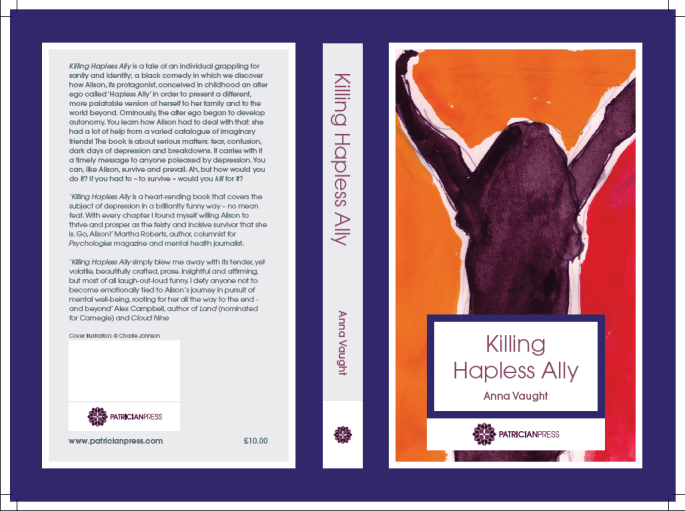
As far as I know, five local (and local-ish) book groups are currently looking at the novel. That is very nice of them. I’ve said that, if I am free and not too far away, I’d love to come and answer questions if a book group would like that. It dawned on me, too, that when I am out and about I should offer to do groups further afield and have also been writing to some wonderful bookshops to that end in mid Wales, Pembrokeshire, Virginia and New York. Oh, what do I sound like? Wales – all over: that’s where my family’s from; the US South is my husband’s patch and NYC isn’t so far from VA where I’ll be visiting mom in the fall. If you’re with a small press – and perhaps anyway – you have to think laterally to get the book out there! But most of all, I just want to reach readers with the book and, where I can, build meaningful encounters and discussions.
So, here are some book group starter questions you could use, if you like. Anna x
Questions for
book groups
Who is Alison and who is Hapless Ally? Are they the same person or two separate people?
Would you describe Hapless Ally as real?
What is your opinion of Santa Maria?
Who is the most horrible person in the book and to whom do you warm most?
What genre do you think the book sits in? Do you call it literary fiction, or does it read as memoir or even, partly, self-help to you? Is it a hybrid?
Did you guess the ending?
What’s the significance of the book’s title? Is it simple and straightforward, or something more complex and nuanced?
Did you like the names for people and places in the book?
Did you take offence to any of the descriptions – for example, of the f…… caravan, the funerals, dying?
There are many literary references shot through the narrative. Some are obvious and documented explicitly in the text (and thus you will see them on the acknowledgements page) but some are harder to spot. So get spotting!
Did you feel that you learned more about mental health from the book?
Did you think that the book gives us insights into therapeutic practice and the sort of help available (although I feel I must add, not routinely available) through our National Health Service in the UK?
Did the book help you? By which I mean, did it make you feel better about your own problems or state of mind? Did it give you a nudge to tackle things that are holding you back and making you unhappy?
Were you able to read it as entertainment, despite some of the themes it addresses?
If you know me, were you able to separate it from me? (This has been an interesting discussion with friends…)
Was the book shocking? If so, why?
Is it a happy ending? Is it over – in a good way?
Who was your favourite imaginary friend – and why? Dolly, Shirley, Albert, JK….
Did you feel sympathy for Santa Maria? For Dad? For Brother who Might as well be Dead? For Terry?
What do you think of Dixie Delicious?
What makes you laugh in the book? Is it the pickled egg murder/horrible deaths/caravan of evil/revenge on the tutus…?
What does the book show us about the power of literature and, more broadly, of the written word? What of the spoken – the “curses ringing”?
I am a mother of three boys, four to fourteen. Some people have asked, ‘Aren’t you worried about what your kids will think?’ Should an author be? Should I, as this author, be?
Why do you think there’s a shift in narrative from first to third person between the prologue and chapter one? Do you think it’s successful?
What’s the significance of the foreword to the rest of the book?
Is Alison strong, or is she weak?
What do you think of having a bibliography in the book? It’s far from a standard feature!
Did all this really happen? Do you believe it did? Why?
Now that last one is, I think, the most interesting question of the lot!



 Anna Vaught Writes - Dr Anna Vaught: teacher, mentor, author, campaigner