Book Groups and Killing Hapless Ally

As far as I know, five local (and local-ish) book groups are currently looking at the novel. That is very nice of them. I’ve said that, if I am free and not too far away, I’d love to come and answer questions if a book group would like that. It dawned on me, too, that when I am out and about I should offer to do groups further afield and have also been writing to some wonderful bookshops to that end in mid Wales, Pembrokeshire, Virginia and New York. Oh, what do I sound like?  Wales – all over: that’s where my family’s from; the US South is my husband’s patch and NYC isn’t so far from VA where I’ll be visiting mom in the fall. If you’re with a small press – and perhaps anyway – you have to think laterally to get the book out there! But most of all, I just want to reach readers with the book and, where I can, build meaningful encounters and discussions.

So, here are some book group starter questions you could use, if you like. Anna x

    Questions for

     book groups

Who is Alison and who is Hapless Ally? Are they the same person or two separate people?

Would you describe Hapless Ally as real?

What is your opinion of Santa Maria?

Who is the most horrible person in the book and to whom do you warm most?

What genre do you think the book sits in? Do you call it literary fiction, or does it read as memoir or even, partly, self-help to you? Is it a hybrid?

Did you guess the ending?

What’s the significance of the book’s title? Is it simple and straightforward, or something more complex and nuanced?

Did you like the names for people and places in the book?

Did you take offence to any of the descriptions – for example, of the f…… caravan, the funerals, dying?

There are many literary references shot through the narrative. Some are obvious and documented explicitly in the text (and thus you will see them on the acknowledgements page) but some are harder to spot. So get spotting!

Did you feel that you learned more about mental health from the book?

Did you think that the book gives us insights into therapeutic practice and the sort of help available (although I feel I must add, not routinely available) through our National Health Service in the UK?

Did the book help you? By which I mean, did it make you feel better about your own problems or state of mind? Did it give you a nudge to tackle things that are holding you back and making you unhappy?

Were you able to read it as entertainment, despite some of the themes it addresses?

If you know me, were you able to separate it from me? (This has been an interesting discussion with friends…)

Was the book shocking? If so, why?

Is it a happy ending? Is it over – in a good way?

Who was your favourite imaginary friend – and why? Dolly, Shirley, Albert, JK….

Did you feel sympathy for Santa Maria? For Dad? For Brother who Might as well be Dead? For Terry?

What do you think of Dixie Delicious?

What makes you laugh in the book? Is it the pickled egg murder/horrible deaths/caravan of evil/revenge on the tutus…?

What does the book show us about the power of literature and, more broadly, of the written word? What of the spoken – the “curses ringing”?

I am a mother of three boys, four to fourteen. Some people have asked, ‘Aren’t you worried about what your kids will think?’ Should an author be? Should I, as this author, be?

Why do you think there’s a shift in narrative from first to third person between the prologue and chapter one? Do you think it’s successful?

What’s the significance of the foreword to the rest of the book?

Is Alison strong, or is she weak?

What do you think of having a bibliography in the book? It’s far from a standard feature!

Did all this really happen? Do you believe it did? Why? 

Now that last one is, I think, the most interesting question of the lot!

A Film I made for AXA PPP and Healthizmo


Watch my little film by clicking on that nice green W.

I made this short film a few weeks ago. It is difficult for me to watch, but I would love to know if what I said – which is entirely me, not scripted – helped you or made you feel comforted. Maybe that you could get better; not feel your days and memories are compromised or scuppered. What I describe in the film is only a little of my experience – but it was important to deliver insight and practical notion here. I hope I have done that.

Anna x

A film I made for AXA PPP and for Healthizmo

Watch my little film by clicking on that nice turquoise W.

I made this short film a few weeks ago. It is difficult for me to watch, but I would love to know if what I said – which is entirely me, not scripted – helped you or made you feel comforted. Maybe that you could get better; not feel your days and memories are compromised or scuppered. What I describe in the film is only a little of my experience – but it was important to deliver insight and practical notion here. I hope I have done that.

Anna x

A SMALL PRESS STATE OF MIND

This is an article commissioned, more on which later.

A SMALL PRESS STATE OF MIND

By Anna Vaught

I have just written a cheery book about misery called Killing Hapless Ally. It started life as a memoir, but, partly because I am not remotely famous (and was thus advised by both an agent and a literary consultancy that I had zero chance of selling my book because who would want to know?) and then partly so Shirley Bassey (read on) wouldn’t come after me, what was a memoir became fiction, but drawing on many real episodes in my own life. And I knew it was a peculiar book; one which didn’t sit neatly in the all-important genre. Its narrative hopped about, in a switch-back sort of fashion, its protagonist had an alter ego who took on a life of her own, it had much colourful cursing and much literary reference threaded through it—from Dante’s The Divine Comedy to Francis Hodgson Burnett’s The Secret Garden and moreover its narrative entertained a gallery of imaginary friends, from John Keats to Albert Camus (not to mention some very satisfying trysts with Shirley Bassey and Dolly Parton). The book offered you families who were grisly and, perhaps, hard to believe (except they were real, quick, or not) and it was, above all, the story of how a little girl conceived some really direful ideas, in a balefully confusing world, about who and what she was. And that girl, that ‘weird kid’ and ‘eldritch child’, went on to have many years of mental health problems and crises and illness and got mopped up by the NHS, a shed load of drugs and, frankly, Albert Camus. Well, I thought it was a comedy. It was, moreorless, my life; all I had known: I had survived it, just about.

But I thought, ‘Who on earth would publish my strange little book?’ I wrote to five agents, two of whom replied with the form no; the other three didn’t reply at all. I found that hard. I mean, I juggle a day job with three young kids, two campaigns, writing a book and articles and so on. Chuck a big and complicated extended family into the mix, too, and the fact that I have to be especially careful that I don’t overdo it because, for me, that way madness lies—which is a bit scary. So not replying at all to submissions because you are so busy seems a bit rude to me; a bit like not marking someone’s essay because I had the rest of the class to do and a bit of lesson planning. (Is immediately blacklisted...) It’s discouraging. I wasn’t sure I was up for it. Not the rejection, because I knew that had to happen; was in fact essential. The not replying bit. I pondered. And then I was reading ‘Mslexia’ and something caught my eye. A small press with an interesting sounding person at the helm; someone with many years of publishing and writing experience. That person was Patricia Borlenghi and the press was Patrician.

I wrote to Patricia; she was intrigued by what I told her of the text—and very keen to have a book about mental health. This was a revelation and a relief, because in that year I had heard agents bemoaning ‘misery memoirs’ and, although I had now tweaked to fiction, I had still felt I would fall foul of the process. Too much misery! And there was the all important notion of genre again. I had just been to a literary festival event where an agent spoke of agents being ‘salespeople, at the end of the day’ and of how a prospective author had to be able to go into a bookshop and see exactly which shelf their book would sit on. But Patrician took my book on almost straight away and we were off.

Patricia herself was a very firm hand. Out went the last chapter. ‘You don’t need it.’ Out went anything she felt frivolous, or repetitive or over-blown. In came THE BEST THINGS, like an extended series of correspondences with Catherine Camus, daughter of Albert, about what they (his twin daughters) would feel acceptable as a portrayal of their father in the book. It wasn’t that they sought to censor, but I invited dialogue because I was such a fan and mindful of the shabby press he has often received. Because when I was a sad and separate teenage girl, it was Albert Camus I talked to. He was one of my most abiding imaginary friends. So I wrote that into life in my book.

There were chats with a patent attorney about whether it was okay to have famous people in my book and the answer was, yes because there’s a hefty disclaimer and anyway, they are all drawn as imaginary friends (I don’t think the attorney had met quite this question before) and besides, the fearless Patricia Borlenghi said, ‘Publish and be damned’ and also, ‘Plus if we do get into trouble, the publicity might well be to our advantage with “Mad mother of three and deaf pensioner in courtroom drama” headline.’ Do bigger publishing houses say things like that? I actually don’t know. I just found it all so exciting. (Even while I was wondering if I’d have to leave town.)

I wrote the first word of the book on the 15th of June (I know that because it was after the A level English Literature exam, for which I had been teaching, and I thought, ‘Oh—now I’ve got a few minutes…’), it had a publisher on the 1st of May the first of the following year and was in print by the following March: twenty months from first word to book launch and I am already a third of the way through book two.

Because here’s the thing.

Patrician took my book because it was thought to be high quality fiction, whether or not it was an unusual text. It has a massive bibliography at the back, for example, which is not standard for a work telling you it’s fiction. It’s literary fiction…yet…could also sit with self-help, for example. Its readers are responding to it in very different ways, accordingly, and it is a fascinating and rewarding process. An adventurous press enabled me to published a risky sort of text, I think. There is much in the book that is, perhaps, unsettling or even upsetting: self harm; hospital visits; therapy; the darkest of epically horrible relatives, a frightening environment for a child and a fear that never went away as an adult. It is—and this is, perhaps, my greatest hope for it—a book about fear told fearlessly. It is supposed to be a black comedy. I lived much of it and learned to thrive because I learned how to make sad or dark into anecdote. Terrible caravans, and loud biblical samplers on the wall and terrifying but lively dead, alive and undead aunts and mothers; and nasty piano teachers and hateful little girls who turned on the wonky little girl who couldn’t and a sibling who left her behind a tree in a dark and shadowy wood to be eaten by the wolves when darkness fell and murdering people with a pickled egg. (You’ll just have to read it to see how this one works out!) And this twenty months I have had have been life changing. Because publishing with a small press allowed me to write the book I wanted to write and gave me a renewed sense of life and direction —which goes way beyond writing the book—into the bargain. I have had over thirty years of mental health problems and I am now largely free of these. It’s not that telling the story in the book was therapeutic exactly (I had the NHS and my incarnation of Albert Camus for that), but releasing it into the world was empowering and healing. I wanted to entertain; I hoped I would pull off something laugh out loud funny about startlingly horrible things and that the humour would provide relief and imaginative counterweight to a tale of how mental health is compromised and damaged and what that means for an individual. Because I knew how and what that meant for me. And that’s the other thing about the small press—and really about Patricia: they did, too.

So, as the book begins, ‘Shall we start at the end? Friend; sympathiser; co-conspirator: read on’. I hope that you will—and that you will enjoy more from the impressive Patrician Press catalogue, too.

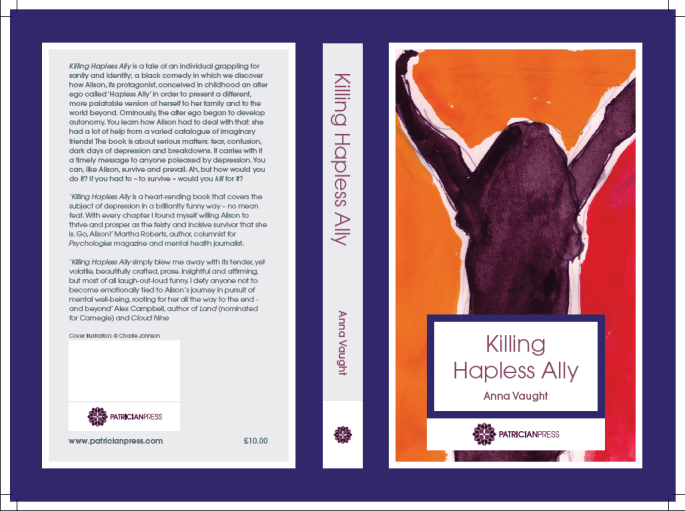
Killing Hapless Ally was published by Patrician Press on March the third, 2016.

ISBN: 978-099323-886-4

Paperback and kindle

http://www.patricianpress.com

http://www.annavaughtwrites.com

Today’s new review of Killing Hapless Ally


Format: Kindle Edition

A new review showing on Amazon this morning.
There are so many things that I like about ‘Killing Hapless Ally’; here are just a few of them:

i The supreme confidence and natural flow of the writing. It was so good to be able to relax almost straightaway and know that I was in the hands of an exceptional writer, who wasn’t going to irritate or pull me up short with sloppy workmanship.

ii The humour, which as the author clearly knows, helps make the parallel tragedy even more palatable and poignant.

iii The intelligence – this is a constant, and very welcome, presence throughout the narrative.

iv Quirkiness: I like this not only because it’s hugely refreshing but also because it feels so spontaneous.

v Subject matter: Whilst an individual’s breakdown is so damaging in its own way, I was most definitely with Alison in her car by the White Horse. Vaught describes the cacophony of the disintegration of the mind superbly.

vi The bravery of the writing: Vaught manages to convey the subject of overwhelming, constant fear with such paradoxical fearlessness.

A Life of Almost and Living with Ally

If you were to look at the  frontispiece to Killing Hapless Ally, you’d see the disclaimer: it’s a work of fiction; no-one real in it and so on. However, there is also a statement that the book is based on episodes in my own life. More is true than a reader might suppose, because you never can tell what occurs in the interior life of another person or within the hidden confines of home. The key thing, though, is that ‘Ally’, Alison, the protagonist’s alter ego, was pretty much real for me. I heard her as a voice, glimpsed her as a shade beside me, as part of myself; I watched myself become her in order to feel more accepted, and I saw her both as myself and as yet another person to hate and pour scorn. It was complicated, the notion of my allegory coming to life.

I have had people write to me and ask whether I thought I was schizophrenic or had a personality disorder and I suppose I can see why the question might be asked, but it was more that, for me, the person I tried to be didn’t work, because it wasn’t me. She was the voice in my head; alternative me. Lots of people weld on what they think is a socially acceptable self; perhaps I just did it in a more complex way – and of course, I also had a gallery of imaginative friends and of course I had a lot of mental health problems and extremely poor coping strategies in the face of stress. But I had The Books: their authors, stories and characters to help me build and re-build. I wasn’t alone.

So, Ally, or someone like her, had been living with me for over thirty years until….well, you’ll have to see what happens in the book! When I wrote it, I gave her a more detailed life and a more delineated character and so she got to hang around, larger than life, while I drafted and re-wrote and finished the book.

Oh – she and I had been together a long time. And I realised that this was why such a creature was a good subject for my book. I breathed life into her and wrote her more fully into being, didn’t I? I lived with her for the longest time. Now, I am doing it with someone else. He’s called ‘Almost’ and he is a lad from the sea and the estuary and the islands of Pembrokeshire. An ‘Almost, down there, kind of kid’. Except he’s not. If you have read Virginia Woolf’s Orlando, you will have a little inkling of what my fluid, adventuring soul might get up to; he isn’t constrained by mind, or time, or identity or even gender; he goes to some extraordinary places and ends up, Forrest Gump-like, in fabulous and terrible and curious places. You don’t know about mermaids called Nerys and Dilys and Elleri? You will. I’d watch out, because these girls can get out of the sea and up the Cleddau estuary and wreak havoc and the truest of love and adventure. And they are hungry for sex and blood. I want to tell you who Muffled Mfanwy (of Killing Hapless Ally) was before she was constrained, by grief, never to speak again. To show you how ‘Almost’ ends up involved in the Melanesian Cargo Cults, where they revere Prince Philip (they do) and what on earth that has to do with Pembrokeshire (okay, I might have made that bit that up). It is certainly a strange story: I am not sure I would know how to write anything that wasn’t. And did I say the book’s biggest influence is Dickens’s Great Expectations, which is probably my favourite book?

So Almost is hanging out with me. Telling me how he got his name, what he planned to do with it, what he’s seen, what he’s missed and -oh!- how he’s loved. I want to ask him if he transcended his name; if he wanted time to stop. Who was the lady from Lawrenny Quay that he could never leave – and where, Almost, did the mermaids go, and why was the sea part of you, Almost, and why did you cross each one, but always come back to the night-world of the quay and the mud and the winking yachts and the lady in the stained raggedy dress who watched from the window of the big old house and she who you loved and loved best?

Almost reassures me that he will tell me all that, but only after I have made him a second breakfast because he’s famished after his global sojourns. And when I have done just that and he has begun to speak, I can start writing his story again.


Goodreads reviews

I was just re-reading a few of the Goodreads reviews for Killing Hapless Ally. I did have my first negative review (well, a three star, accompanied only with the brief comment that the reader got muddled and couldn’t understand it – and I do see that it will have its detractors). Also this week, the book was entered for the 2016 Goldsmith’s prize  – lookee here: http://www.gold.ac.uk/goldsmiths-prize/ , I did a spot of blogging for http://www.selfishmother.com and wrote a guest feature that will go here: http://thecontemporarysmallpress.com/

So some comments:


*I have now read this wonderful book, and think it so brave, true and moving, superbly written and brilliantly funny! Thank you for such courage.

*Wow! This book is incredible.

*I identified with Alison so quickly, I frightened myself. (Mind you, what sort of mother tells their child she was a mistake?) This novel felt like going through psychotherapy. Alison’s struggle out from the depths of depression is here written so beautifully, so intricately, so real. The streams of consciousness left me breathless and the letters written by Alison have inspired me. I am going to write my way through the depths and endure. I rejoice in Alison’s survival.

*This was worth reading. It is a powerful book that gives you a peek behind the mask into a private struggle, a concealed personal experience of being someone who lives with overwhelming levels of shame and self-contempt. We use these terms a lot but in this case it is a military grade phenomenon with significant consequences. So what happens when some-one is really unwanted, really unloved and learns to assume that if some-one else knew them, they would hurt them, reject them. This is what Alison has to live with and this is her story. How she manages to survive and how when the real world becomes unbearable, there are other places to go with other people in them. It’s a demanding book, not an easy read and you have to concentrate, but it’s worth it. The content can be upsetting, the madness difficult to keep up with, but that’s the point. I’ve read loads of accounts of this kind of thing, but rarely is the author up to the task of telling a good story and keeping it up through the whole book. Anna Vaught, the author, is bold and honest. She respects the reader and doesn’t try to protect you so at times you have to put the book down and take a break, but not for long as it is a page turner and you want to know how it turns out. It’s not easy to live with this kind of stuff, the professional help has its limits and it’s a test, but you come away from the book with hope and a belief that although some people can be cruel, not everyone is and sustained kindness can really help.

*Anna Vaught’s debut novel takes us on the helter-skelter ride that is the making of Alison, a seemingly ordinary girl, growing up in ordinary village in an unsuspected, undetected ordinary family. The book spins in ever-increasing circles, starting with the very young Alison, clever, loving and seeking to be lovable, struggling to make sense of the chronic pain she feels from believing she causes others’ pain. That struggle, delivered with humour, much literary wit and visceral determination, forms the book.
Vaught gives us much more than a glimpse into the world of mental illness; how it festers in the least suspected settings, how it can taint even the most brilliant, funny and promising minds and how much strength, inward and outward, is needed for recovery. Through Alison’s misadventures we laugh, often, as she shares with us her many heroes, both imaginary and real, and are prompted to consider the ordinary heroes in our own lives. For Alison’s heroes are the thread which pulls her story together: the sexy poets and popstars, the mums bearing lemon drizzles and cleaning products, the NHS angels who wear expensive-casual to work in vomit-coloured rooms.

Alison declares, after recalling her grandfather’s recitations that ‘…here’s the thing: words can heal. They can make you soar, whether read or heard. And you cannot take them away once brought into the world. Sometimes, they are good even if a bad person said them: because the words can exist independently of the mouth that uttered them or the horrid geography that spawned them. It is magic.

Indeed, it is.