Latest Goodreads review…

I enjoyed finding this review of Killing Hapless Ally this morning. I should love to think that someone would re-read the book and think that it would bear re-reading.


This is a wonderful book. It’s not one that readers of ‘chick lit’ will take to easily. Nothing is spoon fed to the reader. And yet it is expertly written by someone who not only knows their craft, but enjoys it as well. The author has a habit of placing powerfully upsetting lines, lines that make you want to physically jerk when you read them, in the middle of laugh-out-loud funny scenes. The effect is powerful, making the both the humour and the shock support each other with a sort of literary alchemy few writers can achieve.

I feel like the central character Alison is, if not a friend, someone I know inside out now. The book will bear re-reading (several times over I expect) so I am looking forward to meeting her again.’

An exciting new literary prize for small presses and their authors

I am delighted that the award-winning writer, Neil Griffiths, has agreed to be interviewed here. Griffiths has just set up the Republic of Consciousness Prize for small literary presses and their authors and, as a small press author myself, I want to say many thanks to him for that. I am sure that authors with small presses, the presses themselves and readers too will all benefit from the creation of a prize, the intention of which is to shed light on some of the wonderfully exciting work that readers often don’t know about and on the presses which writers may not know they may approach.

But why don’t they?

Why don’t more people know about books from Calisi, or Mother’s Milk, or Patrician Press, or Galley Beggar or Fitzcarraldo, Comma or Linen Press?

Because small presses don’t have the hefty budgets behind them to shift their books into the spotlight. Books from small presses may win major awards – I mention the  truly striking A Girl is a Half-formed Thing‘ by Eimear McBride which was published by Galley Beggar Press and went on to win the Goldsmith’s prize and the Bailey’s among others – but this is very unusual. Small presses may operate at a loss or break even/make a small profit; to run them, their originators may re-mortgage their home or work several jobs to make it happen because they think it is important that it does. But they don’t have big budgets for publicity and their books may not be widely stocked. Yet I want to say that of my five or so favourite books of the past year, four were published by independent (I tend to use the term ‘independent press’ interchangeably with ‘small press’) presses (the fifth was Odysseus Abroad by Amit Chaudhuri, if you want to know) and I admit I also read some BIG selling books that many raved about and which fell flat for me, one of which actually made me cry because I was so disappointed. (It would be churlish to name those, so I won’t.) When Griffiths began to read titles from small presses, something he admits he took a while to do, he was astounded by their quality and wondered what to do. The result was the prize and you can see an account of this in ‘The Guardian’ here

http://www.theguardian.com/books/2016/feb/22/new-award-fiction-small-presses-republic-of-consciousness-neil-griffiths

As I said, I am myself published by a small press, Patrician Press, (www.patricianpress.com) and can tell you that I have learned much from being a part of such. I am a debut novelist and I was put through my paces by a firm and talented editor called Patricia Borlenghi, who is also the founder of the press and is its heart and its everything. Her husband, the artist, Charlie Johnson, designed the cover of my book, she keeps an eye on me, inspires me and chides me as necessary (definitely necessary) and I am blessed to have met her and to be part of the Patrician cohort. She took on my strange little book when I had heard bigger publishers deride ‘misery memoirs’ or even scoff at ‘yet another’ book about mental health or books which did not fit neatly into genre. I am lucky in that I only had two agent rejections, (the other three never replied, which I have written about a bit saucily elsewhere) before I found Patrician. Before I did, I was told by a literary consultancy that I had to be able to go into a bookshop and see straight away which shelf my text would sit on and that, realistically, customers (readers) go into a shop and need to know that they are getting Heinz baked beans and not some ersatz brand or, God forbid, a tin of corned beef.

Obviously, there is some good advice in there; I am not arrogant and I am definitely a rookie. I understand, from the many conversations I’ve had about my book, that I’ve written something which a number of readers describe as ‘difficult’. I knew someone would have to take a chance on my book because it was a bit experimental and didn’t sit so tidily in a genre. I am not sure the next one will either! I don’t know yet what will happen with that (it’s called A Life of Almost – oh, you can tell it’s going to be another strange one if you take a little look at the beginning of my research board here: https://uk.pinterest.com/annacvaught/a-life-of-almost/ ) but suspect I will be sending it to small presses when submissions windows are open – for even small presses receive many manuscripts.

I have loved being with a small press, learning to think laterally, make links, offer to write in all kinds of places for free, do talks, rock up at book groups, put on a very jolly book launch, reply to anyone who asks me about the book (as readers have done), crazily fitting it all in around other little publications (I’m also with www.theemmapress.com later this year), my day job, volunteer posts and three young kids, and to contribute work to those movements which aim to change things – hence an article, called ‘A Small Press State of Mind’, I have just done for https://thecontemporarysmallpress.com/  which will be up at the end of the month. They will also feature Griffiths and his prize very soon, so publication of this interview is a little  taster for that.

I suppose I feel that I have a home. I’m an outlier. But hey, I’ve probably always been that. I just didn’t think there was a place for me as an author, but I underestimated what a wealth of presses and readers were out there! Noli timere if I sound like you. Get out there.  May you find a home for your book, too. And homes for you as a reader. With bookshelves of titles which stretch and tantalise you; which make you re-read books to find new subtleties and ideas.  I wonder if Proust would be stuffed without the indies – the small presses – if he popped up now. And who would take on Faulkner?

But back to Neil Griffiths. Betrayal in Naples won The Author’s Club First Novel Award; his second book, Saving Caravaggio (which I am reading at the moment) was shortlisted for Best Novel in the Costa Book Awards. Both were published by Penguin. But things are a little different now and his new book, The Family of Love, will be placed with an independent press.’We need small presses: they are good at spotting the literary outliers,’ he writes on his  site here http://www.republicofconsciousness.com/2016/02/a-broadside-against-mainstream-publishing/  ‘Their radar is calibrated differently from agents, or mainstream publishers. Small presses don’t ask how many copies will this sell, but how good is this – what is its value as literature? Quality is the only criterion.’

And here is the YouTube launch film for the prize:

https://www.youtube.com/watch?v=JfkUxuAj1UE

SO, AN INTERVIEW WITH NEIL GRIFFITHS ABOUT THE LAUNCH OF THE REPUBLIC OF CONSCIOUSNESS LITERARY PRIZE

Could you tell me why it took you, by your own admission, so long to notice small presses?

I wonder that myself. Possibly bookstore exposure is lacking. Certainly they don’t get the kind of exposure in the book sections of most newspapers. It needs a novel to have already ‘broken out’ for it to be featured. But it’s not all their fault. When something is not on your radar – it gets missed. If I look over my bookshelves there are small presses there, but I guess I didn’t think to wonder about them as having a particular mission – in the sense I didn’t at that point think of any publisher being like that these days. Small presses are a culture, not one particular book – we have to be aware of that culture to notice what it’s doing.

And what about the books you read, for example those by writers at Fitzcarraldo or Galley Beggar Press? How was it they impressed you so much?

The first book I read was Zone by Mathias Enard (Fitzcarraldo), which stunned me. As if I’ve said before, I think it’s the most serious novel ever written. It deals with post-1st World War conflict in Europe, North Africa, and the Middle East from the centre of the consciousness of one man as he tries to wrestle with his own actions. It might be about the darkest points in recent history, but it’s a deeply human novel. And formally interesting – one sentence over its 500+ pages. A work of genius. There is also Playthings by Alex Pheby, from Galley Beggar – based on  a true story, it’s a novel about the lived experience of a 19th century German judge as he descends into madness. Writing of the highest order – it has more control than any novel I think I’ve read, given it’s dealing with vagaries of a shifting phenomenology. More recently Martin John by Anakana Schofeld, from And Other Stories. Any novel that’s about public sexual exposure and manages to be formally exciting and sympathetic deserves attention.

You mentioned in ‘The Guardian’ that your third book would be placed with a small press? Could you tell me why and how the process has been different from that with a big publisher? (Griffiths’s previous two novels were published by Penguin.)

It’s different only in that the people are different. In the end an editor has to read your novel and love it – that’s the same. But my experience of mainstream literary people is that they are mostly risk averse and professionally competitive in a way that disadvantages the writer. All the people I’ve met from small presses seem genuinely in love with great writing, interesting novels, and promoting difficult writers. It’s a mind-set that I suspect most people in publishing once shared, but lost because of the need to keep their job. Someone last week told me that at a large literary agency, each agent had to be bringing in £200k a year in advances just to support their employment. It’s a disincentive to take on a difficult book that will unlikely get a big advance and may only sell 2000 copies (initially).
Another way small presses differ is access. I’ve just placed my new novel with Dodo Ink, to be published Autumn 2017. I met Sam Mills, author and MD, at The Small Presses Fair in Peckham. We talked books, and I pitched her Family of Love, and she wanted to read it.

What do you hope to achieve with the new Republic of Consciousness Prize?

Humble objectives – increase exposure for small presses and their novels so a few hundred, maybe a thousand, more copies are sold.

Have you had a good deal of interest in the prize? I have been reading a number of truly supportive comments on the prize website and on your youtube channel, for example. Conversely, have you received any negative criticism? As a side note, I read the myriad reviews of A Girl is a Half-Formed Thing on Goodreads and Amazon and was fascinated by how divided they were; how a relatively high number of reviewers baulked at its difficulty. How confused, startled or cross readers had been. How others felt it was a work of brilliance and daring. I was thinking, then, of folk sitting, perplexed, in front of Beckett’s ‘Waiting for Godot’, until Harold Hobson and Kenneth Tynan received it warmly and with fascination and the tide turned. I am naturally enchanted by such a polarity in reception; it would make me want to read the book, frankly. I am digressing. Interest in and support for the prize?

Huge support from writers and presses. Now it’s about getting some people with money to support it. I want the prize fund to be large enough to give something to the shortlisted presses as well as the winner. As I’ve said, I’m going to write to the ‘richer’ end of literary novels for donations.

Can you tell me how you went about selecting the judges, the details of whom are now on the prize site?

I needed help, so Nicci Praca – a PR consultant for small presses –  recommended some; and Lisa Campbell from The Bookseller also did the same.

Are you able to tell me just a little about the books you have already received?

What I will say is that the covers have been variable. And production quality perhaps not quite what I expected after the beautiful work of Fitzcarraldo and Galley Beggar – the bible black of Galley Beggar’s first runs are my favourite. And the reason this needs mentioning is that book stores won’t take books that aren’t well produced. Small presses are already at a disadvantage. Make your books beautiful and it will make a difference.

Have you had support from any of the bigger publisher or agents? Has the ‘guilt trip’ notion of getting some other authors with bigger publishers to chip in been successful?

Next on my list.

How might we writers from small presses floor you with our brilliance, then?

The prize is for risk-taking literary fiction – in the sense that doubles the jeopardy for a small press. But in the end, beautifully crafted sentences full of insight into what it means to be human will do it.

I know it’s early days, but might you tell me about any future hopes and dreams for the prize?

Given my new novel is out next year, I want to win my own prize. That’s a joke, obviously. I hope it runs for a few years, and the prize fund is such that it makes a tangible – and that means financial – difference to small presses’ continued existence.

Thank you so much.

Very happy to do it – thank you.


Book Groups and Killing Hapless Ally

As far as I know, five local (and local-ish) book groups are currently looking at the novel. That is very nice of them. I’ve said that, if I am free and not too far away, I’d love to come and answer questions if a book group would like that. It dawned on me, too, that when I am out and about I should offer to do groups further afield and have also been writing to some wonderful bookshops to that end in mid Wales, Pembrokeshire, Virginia and New York. Oh, what do I sound like?  Wales – all over: that’s where my family’s from; the US South is my husband’s patch and NYC isn’t so far from VA where I’ll be visiting mom in the fall. If you’re with a small press – and perhaps anyway – you have to think laterally to get the book out there! But most of all, I just want to reach readers with the book and, where I can, build meaningful encounters and discussions.

So, here are some book group starter questions you could use, if you like. Anna x

    Questions for

     book groups

Who is Alison and who is Hapless Ally? Are they the same person or two separate people?

Would you describe Hapless Ally as real?

What is your opinion of Santa Maria?

Who is the most horrible person in the book and to whom do you warm most?

What genre do you think the book sits in? Do you call it literary fiction, or does it read as memoir or even, partly, self-help to you? Is it a hybrid?

Did you guess the ending?

What’s the significance of the book’s title? Is it simple and straightforward, or something more complex and nuanced?

Did you like the names for people and places in the book?

Did you take offence to any of the descriptions – for example, of the f…… caravan, the funerals, dying?

There are many literary references shot through the narrative. Some are obvious and documented explicitly in the text (and thus you will see them on the acknowledgements page) but some are harder to spot. So get spotting!

Did you feel that you learned more about mental health from the book?

Did you think that the book gives us insights into therapeutic practice and the sort of help available (although I feel I must add, not routinely available) through our National Health Service in the UK?

Did the book help you? By which I mean, did it make you feel better about your own problems or state of mind? Did it give you a nudge to tackle things that are holding you back and making you unhappy?

Were you able to read it as entertainment, despite some of the themes it addresses?

If you know me, were you able to separate it from me? (This has been an interesting discussion with friends…)

Was the book shocking? If so, why?

Is it a happy ending? Is it over – in a good way?

Who was your favourite imaginary friend – and why? Dolly, Shirley, Albert, JK….

Did you feel sympathy for Santa Maria? For Dad? For Brother who Might as well be Dead? For Terry?

What do you think of Dixie Delicious?

What makes you laugh in the book? Is it the pickled egg murder/horrible deaths/caravan of evil/revenge on the tutus…?

What does the book show us about the power of literature and, more broadly, of the written word? What of the spoken – the “curses ringing”?

I am a mother of three boys, four to fourteen. Some people have asked, ‘Aren’t you worried about what your kids will think?’ Should an author be? Should I, as this author, be?

Why do you think there’s a shift in narrative from first to third person between the prologue and chapter one? Do you think it’s successful?

What’s the significance of the foreword to the rest of the book?

Is Alison strong, or is she weak?

What do you think of having a bibliography in the book? It’s far from a standard feature!

Did all this really happen? Do you believe it did? Why? 

Now that last one is, I think, the most interesting question of the lot!

A Film I made for AXA PPP and Healthizmo


Watch my little film by clicking on that nice green W.

I made this short film a few weeks ago. It is difficult for me to watch, but I would love to know if what I said – which is entirely me, not scripted – helped you or made you feel comforted. Maybe that you could get better; not feel your days and memories are compromised or scuppered. What I describe in the film is only a little of my experience – but it was important to deliver insight and practical notion here. I hope I have done that.

Anna x

A Life of Almost and Living with Ally

If you were to look at the  frontispiece to Killing Hapless Ally, you’d see the disclaimer: it’s a work of fiction; no-one real in it and so on. However, there is also a statement that the book is based on episodes in my own life. More is true than a reader might suppose, because you never can tell what occurs in the interior life of another person or within the hidden confines of home. The key thing, though, is that ‘Ally’, Alison, the protagonist’s alter ego, was pretty much real for me. I heard her as a voice, glimpsed her as a shade beside me, as part of myself; I watched myself become her in order to feel more accepted, and I saw her both as myself and as yet another person to hate and pour scorn. It was complicated, the notion of my allegory coming to life.

I have had people write to me and ask whether I thought I was schizophrenic or had a personality disorder and I suppose I can see why the question might be asked, but it was more that, for me, the person I tried to be didn’t work, because it wasn’t me. She was the voice in my head; alternative me. Lots of people weld on what they think is a socially acceptable self; perhaps I just did it in a more complex way – and of course, I also had a gallery of imaginative friends and of course I had a lot of mental health problems and extremely poor coping strategies in the face of stress. But I had The Books: their authors, stories and characters to help me build and re-build. I wasn’t alone.

So, Ally, or someone like her, had been living with me for over thirty years until….well, you’ll have to see what happens in the book! When I wrote it, I gave her a more detailed life and a more delineated character and so she got to hang around, larger than life, while I drafted and re-wrote and finished the book.

Oh – she and I had been together a long time. And I realised that this was why such a creature was a good subject for my book. I breathed life into her and wrote her more fully into being, didn’t I? I lived with her for the longest time. Now, I am doing it with someone else. He’s called ‘Almost’ and he is a lad from the sea and the estuary and the islands of Pembrokeshire. An ‘Almost, down there, kind of kid’. Except he’s not. If you have read Virginia Woolf’s Orlando, you will have a little inkling of what my fluid, adventuring soul might get up to; he isn’t constrained by mind, or time, or identity or even gender; he goes to some extraordinary places and ends up, Forrest Gump-like, in fabulous and terrible and curious places. You don’t know about mermaids called Nerys and Dilys and Elleri? You will. I’d watch out, because these girls can get out of the sea and up the Cleddau estuary and wreak havoc and the truest of love and adventure. And they are hungry for sex and blood. I want to tell you who Muffled Mfanwy (of Killing Hapless Ally) was before she was constrained, by grief, never to speak again. To show you how ‘Almost’ ends up involved in the Melanesian Cargo Cults, where they revere Prince Philip (they do) and what on earth that has to do with Pembrokeshire (okay, I might have made that bit that up). It is certainly a strange story: I am not sure I would know how to write anything that wasn’t. And did I say the book’s biggest influence is Dickens’s Great Expectations, which is probably my favourite book?

So Almost is hanging out with me. Telling me how he got his name, what he planned to do with it, what he’s seen, what he’s missed and -oh!- how he’s loved. I want to ask him if he transcended his name; if he wanted time to stop. Who was the lady from Lawrenny Quay that he could never leave – and where, Almost, did the mermaids go, and why was the sea part of you, Almost, and why did you cross each one, but always come back to the night-world of the quay and the mud and the winking yachts and the lady in the stained raggedy dress who watched from the window of the big old house and she who you loved and loved best?

Almost reassures me that he will tell me all that, but only after I have made him a second breakfast because he’s famished after his global sojourns. And when I have done just that and he has begun to speak, I can start writing his story again.


Goodreads reviews

I was just re-reading a few of the Goodreads reviews for Killing Hapless Ally. I did have my first negative review (well, a three star, accompanied only with the brief comment that the reader got muddled and couldn’t understand it – and I do see that it will have its detractors). Also this week, the book was entered for the 2016 Goldsmith’s prize  – lookee here: http://www.gold.ac.uk/goldsmiths-prize/ , I did a spot of blogging for http://www.selfishmother.com and wrote a guest feature that will go here: http://thecontemporarysmallpress.com/

So some comments:


*I have now read this wonderful book, and think it so brave, true and moving, superbly written and brilliantly funny! Thank you for such courage.

*Wow! This book is incredible.

*I identified with Alison so quickly, I frightened myself. (Mind you, what sort of mother tells their child she was a mistake?) This novel felt like going through psychotherapy. Alison’s struggle out from the depths of depression is here written so beautifully, so intricately, so real. The streams of consciousness left me breathless and the letters written by Alison have inspired me. I am going to write my way through the depths and endure. I rejoice in Alison’s survival.

*This was worth reading. It is a powerful book that gives you a peek behind the mask into a private struggle, a concealed personal experience of being someone who lives with overwhelming levels of shame and self-contempt. We use these terms a lot but in this case it is a military grade phenomenon with significant consequences. So what happens when some-one is really unwanted, really unloved and learns to assume that if some-one else knew them, they would hurt them, reject them. This is what Alison has to live with and this is her story. How she manages to survive and how when the real world becomes unbearable, there are other places to go with other people in them. It’s a demanding book, not an easy read and you have to concentrate, but it’s worth it. The content can be upsetting, the madness difficult to keep up with, but that’s the point. I’ve read loads of accounts of this kind of thing, but rarely is the author up to the task of telling a good story and keeping it up through the whole book. Anna Vaught, the author, is bold and honest. She respects the reader and doesn’t try to protect you so at times you have to put the book down and take a break, but not for long as it is a page turner and you want to know how it turns out. It’s not easy to live with this kind of stuff, the professional help has its limits and it’s a test, but you come away from the book with hope and a belief that although some people can be cruel, not everyone is and sustained kindness can really help.

*Anna Vaught’s debut novel takes us on the helter-skelter ride that is the making of Alison, a seemingly ordinary girl, growing up in ordinary village in an unsuspected, undetected ordinary family. The book spins in ever-increasing circles, starting with the very young Alison, clever, loving and seeking to be lovable, struggling to make sense of the chronic pain she feels from believing she causes others’ pain. That struggle, delivered with humour, much literary wit and visceral determination, forms the book.
Vaught gives us much more than a glimpse into the world of mental illness; how it festers in the least suspected settings, how it can taint even the most brilliant, funny and promising minds and how much strength, inward and outward, is needed for recovery. Through Alison’s misadventures we laugh, often, as she shares with us her many heroes, both imaginary and real, and are prompted to consider the ordinary heroes in our own lives. For Alison’s heroes are the thread which pulls her story together: the sexy poets and popstars, the mums bearing lemon drizzles and cleaning products, the NHS angels who wear expensive-casual to work in vomit-coloured rooms.

Alison declares, after recalling her grandfather’s recitations that ‘…here’s the thing: words can heal. They can make you soar, whether read or heard. And you cannot take them away once brought into the world. Sometimes, they are good even if a bad person said them: because the words can exist independently of the mouth that uttered them or the horrid geography that spawned them. It is magic.

Indeed, it is.

Read a sample of Killing Hapless Ally here

If you click on the link below, you can read a short sample of the book from Kindle Cloud at Amazon. I hope you go on to buy the book. Support your local bookseller, order it in – or find the book at Waterstones online or, indeed, on Amazon for both paperback and kindle copies. I am sure you already know this, but Amazon subscribers get the book for free. I’d love you to leave me a review, though (at either site or on my goodreads page) – and to be able to discuss the book with as many people and as wide a group of people as possible.

Anna.


A review from Goodreads that moved me greatly and starter questions for book groups

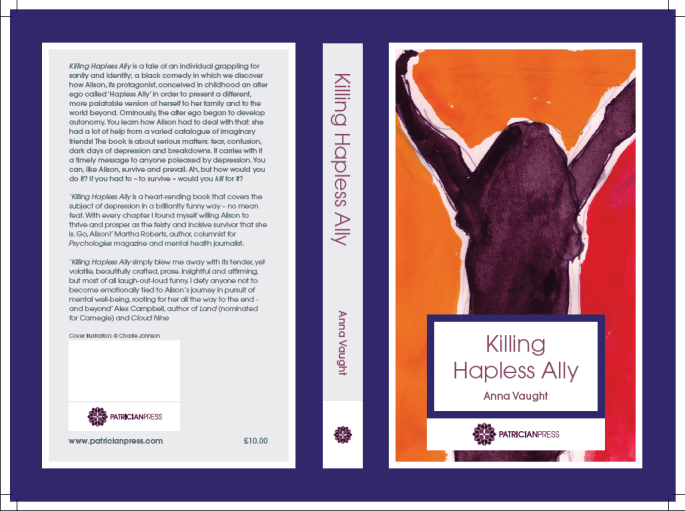
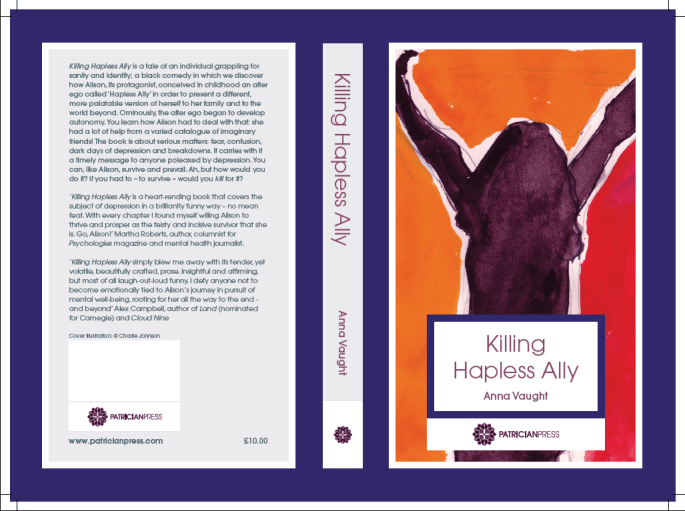
I have so been enjoying listening to feedback from readers of Killing Hapless Ally.  I know it is also being read for two local book groups, so if you fancy reading it for yours, I have added some suggested reading group questions, as given in an earlier post. The book is free on kindle to Amazon subscribers – although I must say that the paperback is a substantial, beautiful white and lilac thing with a striking cover by artist Charlie Johnson,

Here is the last review for the book, this one at http://www.goodreads.com this afternoon, followed by book group starters for you.

I received a signed copy of this book through Goodreads Giveaways – thank you very much – but this has not influenced my review. 

Wow! This book is incredible.

I identified with Alison so quickly, I frightened myself. (Mind you, what sort of mother tells their child she was a mistake?) This novel felt like going through psychotherapy. Alison’s struggle out from the depths of depression is here written so beautifully, so intricately, so real. The streams of consciousness left me breathless and the letters written by Alison have inspired me. I am going to write my way through the depths and endure. I rejoice in Alison’s survival.


Questions for book groups.

Who is Alison and who is Hapless Ally? Are the same person or two separate people?

Would you describe Hapless Ally as real?

What is your opinion of Santa Maria?

Who is the most horrible person in the book and to whom do you warm most?

Did you guess the ending?

What’s the significance of the book’s title? Is it simple and straightforward, or something more complex and nuanced?

Did you like the names for people and places in the book?

Did you take offence to any of the descriptions – for example, of the f…… caravan, the funerals, dying?

There are many literary references shot through the narrative. Some are obvious and documented explicitly in the text (and thus you will see them on the acknowledgements page) but some are harder to spot. So get spotting!

Did you feel that you learned more about mental health from the book?

Did you think that the book gives us insights into therapeutic practice and the sort of help available (although I feel I must add, not routinely available) through our National Health Service in the UK?

Did the book help you? By which I mean, did it make you feel better about your own problems or state of mind? Did it give you a nudge to tackle things that are holding you back and making you unhappy?

Was the book shocking? If so, why?

Is it a happy ending? Is it over – in a good way?

Who was your favourite imaginary friend – and why? Dolly, Shirley, Albert, JK….

Did you feel sympathy for Santa Maria? For Dad? For Brother who Might as well be Dead? For Terry?

What do you think of Dixie Delicious?

What makes you laugh in the book? Is it the pickled egg murder/horrible deaths/caravan of evil/revenge on the tutus…?

What does the book show us about the power of literature and, more broadly, of the written word? What of the spoken – the “curses ringing”?

Why do you think there’s a shift in narrative from first to third person between the prologue and chapter one? Do you think it’s successful?

What’s the significance of the foreword to the rest of the book?

Is Alison strong, or is she weak?

Did all this really happen? Do you believe it did? Why?


Book groups and readings!

I am about to establish a year’s worth of Killing Hapless Ally events, (while I am writing the next one, working title A Life of Almost) so just to say that there will be a couple of local and local (ish!) talks, hopefully a collaboration (musicians; other authors..) and also that if you have a book group not too far away (West Wilts, Bath and Bristol – South and West Wales even as I am often there), then if you order the books from the wonderful Mr B’s Bookshop in Bath, I hereby promise to turn up at your book group to answer questions if you would like – and will even bring cake! How about that? I was speaking last night to other authors about this as they have done some reading groups and found it a great thing to do. So let me know! If I am there, you can ask me anything about the book’s content – anything you like – and feel free to tell me its flaws!

And I had the best launch at Mr B’s Bookshop!


Launch tomorrow and something for book groups!

So tomorrow is the launch of Killing Hapless Ally and it occurred to me that, since we haven’t published book group questions and starting points at the back of the book, I’d do some here. You know, in case, wherever you are in the world, you belong to a book group and would like to tackle the book  (as I know a couple of book groups local to me are already planning to do) – maybe with a few ideas to get you going?

Who is Alison and who is Hapless Ally? Are the same person or two separate people?

Would you describe Hapless Ally as real?

What is your opinion of Santa Maria?

Who is the most horrible person in the book and to whom do you warm most?

Did you guess the ending?

What’s the significance of the book’s title? Is it simple and straightforward, or something more complex and nuanced?

Did you like the names for people and places in the book?

Did you take offence to any of the descriptions – for example, of the f…… caravan, the funerals, dying?

There are many literary references shot through the narrative. Some are obvious and documented explicitly in the text (and thus you will see them on the acknowledgements page) but some are harder to spot. So get spotting!

Did you feel that you learned more about mental health from the book?

Did you think that the book gives us insights into therapeutic practice and the sort of help available (although I feel I must add, not routinely available) through our National Health Service in the UK?

Did the book help you? By which I mean, did it make you feel better about your own problems or state of mind? Did it give you a nudge to tackle things that are holding you back and making you unhappy?

Was the book shocking? If so, why?

Is it a happy ending? Is it over – in a good way?

Who was your favourite imaginary friend – and why? Dolly, Shirley, Albert, JK….

Did you feel sympathy for Santa Maria? For Dad? For Brother who Might as well be Dead? For Terry?

What do you think of Dixie Delicious?

What makes you laugh in the book? Is it the pickled egg murder/horrible deaths/caravan of evil/revenge on the tutus…?

What does the book show us about the power of literature and, more broadly, of the written word? What of the spoken – the “curses ringing”?

Why do you think there’s a shift in narrative from first to third person between the prologue and chapter one? Do you think it’s successful?

What’s the significance of the foreword to the rest of the book?

Is Alison strong, or is she weak?

Did all this really happen? Do you believe it did? Why?