Ta da! This is the next book I am in.


Ta da! This is the next book I am in.
Ah, I struggle with a synopsis, but here you go. THE NEXT (alongside the other stuff).
This is for you, Alex Campbell. x
Anna Vaught
The Life of Almost
or,
A Life Of Very Little Expectation
A synopsis
The Life of Almost is a re-working of the story in Charles Dickens’s Great Expectations, shifting its setting to a wild, mysterious and comical rural South West Wales, the West Country and the suburbs of London. Some characters are based on those found in its stimulus, but others are original —such as Evans the Bodies, keeper of the mortuary and devoted to his Dead Dears. And Muffled Mfanwy, who works with him and with whom Evans has been in love his entire life; their story in startling surroundings is a counterpoint to other love stories in the book, such as that between Almost and the cruel Seren, adopted daughter of the claw-handed spinster Miss Davies, at Clandestine House off the sea coast on the Cleddau Estuary.
Almost is a boy with poor beginnings, who begins his life shrouded by bereavement, the struggling, the bitter and those on the run from the law and from life; he is also surrounded by the hauntings of the undead of his family and the cliff-top communities around him. He plays in the sea caves, visits graves, like Pip, sings into the sea and likes to tell stories—and telling stories is a key theme of the book. Many strands of the narrative I took not from Dickens but from the oral tradition of my large Pembrokeshire family, such as accounts of poltergeists throwing furniture and vases from the fireplace, gibbering dead and moss that caught your foot and sucked at you if you didn’t move quickly enough; things that enthralled and terrified me as a small child. The drownings, skewerings and disappearances that have always rattled in my imagination find form in The Life of Almost.
Almost is dragged up by his sister Perfection, both of them kept in their place from beyond the grave by their mother and grandmother. Almost cries with the name his late mother gave him because he feels he will never amount to much, but gradually he begins to realise that, by calling to the world around him and by telling stories, extraordinary things begin to happen. For Almost is, really, an extraordinary boy.
Almost has, like Pip, a secret benefactor and a true love; he has his own convict and a cruel sister, but this re-working of the story adds more spectral, supernatural elements and more comedy in that Almost, through his story-telling develops the gift of moving through time and through form so as to come and rescue others from suffering, hardship and the loneliness of loss. It is at this point, at the beginning of the book, where we meet him, when as he appears to Catherine who begins the story, sitting, lost and stifled “in the squalid summer of 2016”.
Almost is supported by his devoted mermaids, Dilys and Nerys, who follow him, changing form (I have drawn on extensive mermaid lore in my research for the book), and by a number of friends in different locations. But readers of Great Expectations, would recognise adaptations of characters, such as Pip’s friend, Herbert Pocket, Miss Havisham, Estella and Jaggers (the latter, for example, recast as a lugubrious but prosperous journeyman, basking in his gold and quoting Jonson’s Volpone from his gated community a long way from Almost’s Pembrokeshire!).
I have allowed some risk-taking with the novel’s form in its use of original poems as epigraphs, all of which key in to the themes in the novel, as they describe the dark vagaries of the Welsh landscape, which is itself a key character in the book, living and breathing and casting penumbra and surrounded by the sea. I have also offered two endings to the love story in my book because I wanted to bring to mind how Great Expectations might have been radically altered in its reception, had Dickens been encouraged to use his original ending, far more melancholy that that which replaced it.
So…if you have read and liked my debut novel, Killing Hapless Ally, and it meant something to you; if it made you laugh; you thought it had weight; if it made you fall madly in love with Albert Camus or understand what mental health problems or mental illness might be like (my publisher makes it clear at the beginning of the book that I drew on many episodes in my own life; if you like semi colons, Dolly Parton, poetry and laughing at the dark things…go on, vote for it. The article that follows is from ‘The Guardian’ and below is the link you need to click on, register with ‘The Guardian’, then offer your vote. Actually, there should be two votes, but you need only comment on one of the books.
And look at all those indies! What follows, then, is from ‘The Guardian’; just underneath it, I’ve copied my votes.
**********************************************
Not the Booker prize (very) longlist 2016: votes, please!
If you felt this year’s Man Booker selection was not broad enough, get a load of ours. And help decide which books make the shortlist

Last week the Man Booker longlist was announced. A little surprising, right?
OK, I’m happy to admit that the main prize has a few things going for it. But I always feel that its longlist is just as notable for its omissions as the books that are chosen. This year was no exception. A few good books sometimes sneak on there – but dozens more don’t make it. And you know what? The Booker’s so-called longlist isn’t even that long. Not like the Not the Booker. As you will see below, our list really is long.
There are well over 100 books, making 2016 a record year already. So thank you to everyone who has contributed so far. And I hope you stick around as the real work begins. Because we somehow have to whittle this mighty list down to a manageable half-dozen books.
And how do we do that? We vote! If you want to take part, all you have to do is choose two books from the longlist, from two different publishers, and accompany those votes with a short review of at least one of your chosen books. It would also be very helpful if you included the word “vote”.
The review should be something over 100 words long, although as our glorious and shining Terms and Conditions state, we won’t be counting that carefully. Just make it look like you care.
It’s that simple. So let’s get voting. You’ve got just over a week. The deadline is 23.59 on 14 August 2016. The contenders are:
Megan Abbott– You Will Know Me (Picador)
Lesley Allen – The Lonely Life of Biddy Weir (Twenty7)
Deborah Andrews – Walking the Lights (Freight Books)
Louis Armand – The Combinations (Equus)
Kate Armstrong – The Storyteller (Holland House)
Jason Arnopp – The Last Days of Jack Sparks (Orbit)
Jenn Ashworth – Fell (Sceptre)
Chris Bachelder – The Throwback Special (WW Norton & Company)
Jo Baker – A Country Road, A Tree (Doubleday)
Julian Barnes – The Noise of Time (Jonathan Cape)
Shirley Barrett – Rush Oh! (Little, Brown)
Kevin Barry – Beatlebone (Doubleday)
Louise Beech – The Mountain in My Shoe (Orenda)
Claire-Louise Bennett – Pond (Fitzcarraldo)
Bill Beverly – Dodgers (No Exit Press)
Lochlan Bloom – The Wave (Dead Ink)
Lisa Blower – Sitting Ducks (Fair Acre)
Megan Bradbury – Everyone Is Watching (Picador)
Caroline Brothers – The Memory Stones (Bloomsbury)
Liam Brown – Wild Life (Legend Press)
Rowan Hisayo Buchanon – Harmless Like You (Sceptre)
Tom Bullough – Addlands (Granta)
Paul Burston – The Black Path (Accent Press Ltd)
Jackie Buxton – Glass Houses (Urbane Publications)
Louise Candlish – The Swimming Pool (Penguin)
Joanna Cannon – The Trouble With Goats and Sheep (The Borough Press)
Emma Chapman – The Last Photograph (Picador)
Anna Chilvers – Tainted Love (Bluemoose)
Dan Clements – What Will Remain (Silvertail)
Clár Ni Chonghaile – Fractured (Legend Press)
Chris Cleave – Everyone Brave Is Forgiven (Sceptre)
Emma Cline – The Girls (Chatto & Windus)
Paul MM Cooper – River of Ink (Bloomsbury)
Mark Connors – Stickleback (Armley Press)
Isabel Costello – Paris Mon Amour (Canelo)
Jack Cox – Dodge Rose (Dalkey Archive Press)
Justin Cronin – The City of Mirrors (Orion)
Rachel Cusk – Transit (Jonathan Cape)
Shelley Day – The Confession of Stella Moon (Contraband)
Don DeLillo – Zero K (Picador)
Ruth Dugdall – Nowhere Girl (Legend Press)
Sophie Duffy – Bright Stars (Legend Press)
Ken Edwards – Country Life (Unthank Books)
Jo Ely – Stone Seeds (Urbane Publications)
Guillermo Erades – Back to Moscow (Scribner UK)
Pamela Erens – Eleven Hours (Atlantic Books)
Lyn G Farrell – The Wacky Man (Legend Press)
Julia Forster – What a Way to Go (Atlantic Books)
Harry Gallon – The Shapes Of Dogs’ Eyes (Dead Ink)
Ruth Gilligan – Nine Folds Make A Paper Swan (Atlantic Books)
Jules Grant – We Go Around in the Night and Are Consumed By Fire (Myriad)
Guinevere Glasfurd – The Words in My Hand (Two Roads)
Garth Greenwell – What Belongs to You (Farrar, Straus and Giraux)
David John Griffin – Infinite Rooms (Urbane Publications)
Michael Grothaus – Epiphany Jones (Orenda Books)
Lee Harrison – The Bastard Wonderland (Wrecking Ball Press)
Adam Haslett – Imagine Me Gone (Little Brown and Company)
Noah Hawley – Before the Fall (Hodder & Stoughton)
Matt Hill – Graft (Angry Robot)
Catherine Hokin – Blood and Roses (Yolk Publishing)
Anna Hope – The Ballroom (Doubleday)
Michael Hughes – The Countenance Divine (John Murray)
Dave Hutchinson – Europe at Midnight (Solaris)
Amanda Jennings – In Her Wake (Orenda Books)
Elnathan John – Born on a Tuesday (Cassava Republic)
Anjali Joseph – The Living (Fourth Estate)
Avril Joy – Sometimes a River Song (Linen Press)
Mireille Juchau – The World Without Us (Bloomsbury)
James Kelman – Dirt Road (Canongate)
Claire King – Everything Love Is (Bloomsbury)
Hannah Kohler – The Outside Lands (Picador)
John Lake – Amy and the Fox (Armley Press)
Jem Lester – Shtum (Orion)
Ashley Lister – Raven and Skull (Caffeine Nights Publishing)
Carol Lovekin – Ghostbird (Honno Welsh Women’s Press)
PK Lynch – Armadillos (Legend Press)
Martin MacInnes – Infinite Ground (Atlantic Books)
Kevin MacNeil – The Brilliant and Forever (Polygon)
Seraphina Madsen – Dodge and Burn (Dodo Ink)
Brooke Maganti – The Turning Tide (W&N)
Ayisha Malik – Sophia Khan is Not Obliged (Twenty7)
Michael J Malone – Bad Samaritan (Contraband)
Iain Maloney – The Waves Burn Bright (Freight Books)
Sarah Ladipo Manyika – Like a Mule Bringing Ice Cream to the Sun (Cassava Republic Press)
Alex Marwood – The Darkest Secret (Sphere)
Colum McCann – Thirteen Ways of Looking (Bloomsbury)
Tiffany McDaniel – The Summer That Melted Everything (Scribe)
Ian McGuire – The North Water (Scribner UK)
Elizabeth McKenzie – The Portable Veblen (Penguin Press)
Wyl Menmuir – The Many (Salt)
Sarah Meyrick – Knowing Anna (SPCK Publishing)
Dan Micklethwaite – The Less Than Perfect Legend of Donna Creosote(Bluemoose)
China Miéville – This Census Taker (Del Rey Books)
Kei Miller – Augustown (W&N)
Alan Moore – Jerusalem (Liveright and Knockabout)
Alison Moore – Death and the Seaside (Salt)
Claire Morrall – When the Floods Came (Sceptre)
Yelena Moskovich – The Natashas (Serpent’s Tail)
Sarah Moss – The Tidal Zone (Granta Books)
Sylvain Neuvel – Sleeping Giants (Del Rey Books)
Carl Neville – Resolution Way (Repeater Books)
Suzy Norman – Duff (Patrician Press)
Claire North – The Sudden Appearance of Hope (Orbit)
Barney Norris – Five Rivers Met on a Wooded Plain (Doubleday)
Edna O’Brien – The Little Red Chairs (Faber & Faber)
Paraic O’Donnell – The Maker of Swans (W&N)
Maggie O’Farrell – This Must Be the Place (Tinder Press)
Harry Parker – Anatomy of a Soldier (Faber & Faber)
Sarah Perry – The Essex Serpent (Serpent’s Tail)
Cherry Potts – The Dowry Blade (Arachne Press)
Laura Powell – The Unforgotten (Freight Books)
Christopher Priest – The Gradual (Gollancz)
Lucy Ribchester – The Amber Shadows (Simon & Schuster UK)
Mary-Jane Riley – After She Fell (Killer Reads)
Adam Roberts – The Thing Itself (Gollancz)
Lou Rowan – A Mystery’s No Problem (Equus)
Amanda Saint – As If I Were a River (Urbane Publications)
James Sallis – Willnot (No Exit Press)
David Savill – They Are Trying to Break Your Heart (Bloomsbury)
Anakana Schofield – Martin John (And Other Stories)
Helen Sedgwick – The Comet Seekers (Harvill Secker)
Lionel Shriver – The Mandibles (The Borough Press)
Karin Slaughter – The Kept Woman (Century)
Ethyl Smith – Changed Times (ThunderPoint Publishing)
Francis Spufford – Golden Hill (Faber & Faber)
Sarayu Srivatsa – If You Look For Me I Am Not Here (Bluemoose)
Elizabeth Strout – My Name Is Lucy Barton (Viking)
Emma Claire Sweeney – Owl Song at Dawn (Legend Press)
M Suddain – Hunters and Collectors (Jonathan Cape)
Graham Swift – Mothering Sunday (Scribner UK)
David Szalay – All That Man Is (Jonathan Cape)
Jonathan Taylor – Melissa (Salt Publishing)
William Thacker – Lingua Franca (Legend Press)
Yusuf Toropov – Jihadi: A Love Story (Orenda Books)
Anna Vaught – Killing Hapless Alley (Patrician Press)
Dan Vyleta – Smoke (W&N)
Natasha Walter – A Quiet Life (The Borough Press)
Simon Wan – Love and a Dozen Roast Potatoes (Urbane Publications)
Eleanor Wasserberg – Foxlowe (Harper Collins)
Jemma Wayne – Chains of Sand (Legend Press)
Aliya Whitely – The Arrival of the Missives (Unsung Stories)
Chis Whitaker – Tall Oaks (Twenty7)
Hugo Wilcken – The Reflection (Melville House UK)
Matt Wilven – The Blackbird Singularity (Legend Press)
Charlotte Wood – The Natural Way of Things (Allen & Unwin)
James Yorkston – Three Craws (Freight Books)
I’ll be back here on 15 August to post the results – and no doubt feeling slightly frazzled from all the counting. Let’s go!
***********************************
And here are my two votes:
My two votes. PK Lynch’s Armadillos (Legend). Aggie’s voice clear as a bell and has stayed with me; excellent, sustained narrative. Admittedly I did find elements of this difficult to read because of experiences I share with Aggie, but I am glad I kept going. One of the biggest compliments I can give to this book is that she has (and I want to qualify that I am a huge Faulkner fan and of Southern literature in general plus it’s my second home and I’m married to A Georgia Boy!) pulled off the voice, the vocabulary and the nuance, which is no mean feat and something I have seen done poorly elsewhere. The settings are haunting and there are elements of joy and humour in the blackness. It reminded me of a book that is too little known – Erskine Cauldwell’s God’s Little Acre – with its grisly portrayal of the characters PK has as ‘subs’. I think Armadillos is a skilfully written book and its prose is spare but allusive. At least, that is how it seemed to me! I felt I knew all along what the ending would be. Knew it inchoately. Didn’t spoil my enjoyment of the story at all. A familiar -oh yes- and beautiful book.
Book two. Duff by Suzy Norman (Patrician Press). Skilfully done; restrained prose; funny; love the journey and the landscape – its sweep of places, visited and remembered. It is sweet, sad and moving. I felt the rhythms of Dylan Thomas, prose and poetry, moving within it.
I’d love to discuss both these books with their authors. Both are debut novelists. Right, I am off to read A Country Road, A Tree, Solar Bones, The Blackbird Singularity and Sometimes a River Song…I am only sorry I cannot nominate more books. It has, for example, been such a brilliant year for smaller presses!
Anna
********************************************
I am crying a little bit here. But read on. It’s fine, really.
Do you know, I am nominated several times for ‘The Guardian’ Not the Booker prize, I am entered for the Goldsmith’s Prize, the new Republic of Consciousness Prize and The Wellcome Book Prize. I also put in a poetry pamphlet for ‘Mslexia”s annual competition.
Do I have a shot? Naaah, not really.
Well, frankly, only a tiny one, at best.
I’m small fry; I’m a newbie and pretty unrefined, still. I blundered into this in the same naive way I have blundered into most things in my life! I sort of…had a go when theoretically it wasn’t supposed to be possible with all my other commitments. I’m a hard worker because, I think, I have had so much experience compromised by mental health problems, illness and bereavement that it has made me more imaginative and keen to seize the day in case we are hit by an asteroid or I go bonkers again (which I am not planning to, obviously). If this is you too, be collected; be encouraged: you would be amazed what is possible and at the way which can be made from no way and from despair.
AND SOMEHOW
In two years, I have written and published a novel, a poetry pamphlet, guest blogged, authored ten articles or so and at this point I am approximately two thirds of the way through a second novel and have poetry and short story publication this autumn and in the spring. So HOLY F*** three kids and a day job and the volunteer stuff. I have to keep going now, don’t I?
On, blunder on. xxx

 Published February 1st, 2017
Prices
£3.99 (e-book)
£8.00 (print)
ISBN
9780993494543 (e-book)
9780993494567 (print)
This anthology of poems and short stories is the result of short-listed works from a competition Patrician Press ran in 2016 on the themes of Refugees and Peace-Seekers. The entries were judged by Joceline Bury, Anna Johnson, Emma Kittle-Pey and Petra McQueen.
The selected works are now included in the anthology. Further contributions from Patrician Press and other authors are as follows: Emma Kittle-Pey, Petra McQueen, Suzy Norman, Robert Ronsson, Sara Elena Rossetti, Anna Vaught, Kenneth Steven and more. Some of the latter works are much more loosely connected to the original themes.
The collection is edited by Anna Johnson who has also written the introduction.

Updated. I think that’s probably it for 2016 with the books I’ve just ordered or bought…
A sixth form student asked me which books I’d read so far this year and could I list them for her – so here you go. Hope I’ve not forgotten anything. The list comprises fiction and non fiction I have read since new year and doesn’t include things that I have needed to read or re-read for English teaching, such as novels, poems, short stories, non-fiction texts, web texts, articles, essays and reviews – or blog posts, poems, magazines, journals and papers that I have read outside of this. And the list doesn’t include my own novel, published on 3rd March this year or the series of features I have written this year – or the poems or the bits of research I’ve been doing for the next book or the books I’ve read to or shared with the kids! Actually, all that adds up to a lot, now I think about it! But here’s the list you asked for, Sasha. And it’s fun to see what people read: you’ll see there are a couple of Horrible Histories in there. I love Horrible Histories. x
No reviews here: haven’t quite had time, what with writing the second book, the day job, the litter of boys, the MH stuff, the PTA…anyway, I think this is it, so far…
The Loney: Andrew Michael Hurley
Galaxy: Explore the Universe, Planets and Stars (Collins). I pinched this from one of the kids and plan to read a great deal more on the subject now that I’m clear what a neutron star is…
1.2 Billion: Mahesh Rao (short stories)
It’s All in Your Head: Suzanne O’ Sullivan. I thought this was fascinating and compassionate and I also trawled through many reviews, which were fascinating in themselves: she has had many detractors for her observations on ME, in particular.
Reasons to Stay Alive: Matt Haig. It was nice to meet him at an event in Toppings Bookshop, too. I thought he spoke with humour and compassion; I was also aware that some members of his audience were acutely anxious about situations in their own lives or in those of their loved ones. Conversations were had; questions were asked. I have struggled with mental health problems since I was a child. I wondered if, in writing the book, he had subsequently felt burdened by others’ concerns and by their sadness.
The Seven Storey Mountain: Thomas Merton
The Death of the Heart: Elizabeth Bowen
Playthings: Alex Pheby
A Girl is a Half-Formed Thing: Eimear McBride
Horrible Histories – Henry VIII and his Wicked Wives and Cut-throat Celts
The Outsider: Colin Wilson
Orlando: Virginia Woolf
Duff: Suzy Norman
A Country Road. A Tree: Jo Barker
In Her Wake: Amanda Jennings
Armadillos: P.K. Lynch.
Local Girl Missing: Claire Douglas.
Middlemarch: George Eliot. (This was a re-read. I hadn’t looked at it properly for years and, of course, I was glad I did.)
The Last Act of Love: Cathy Rentzenbrink
Cloud Nine: Alex Campbell
Depression: The Way Out Of Your Prison: Dorothy Rowe (read for the third time!)
We Are All Completely Beside Ourselves: Karen Joy Fowler
Our Mutual Friend: Charles Dickens (second reading) and Great Expectations (a third)
The Story of Blanche and Marie: Per Olov Enquist
This Book is Gay and Mind Your Head: Juno Dawson. I do think these are excellent books on sexuality and identity and on mental health for young people. Juno is a YA novelist too and used to be a PSHE teacher.
The Bell Jar: Sylvia Plath (second reading)
Crap Towns. The 50 Worst Places to Live In The UK (ed. Sam Jordison and Dan Kieran).
The Beckoning Silence: Joe Simpson
Very British Problems. Rob Temple.
How Novels Work: John Mullan
Lost at Sea. The Jon Ronson Mysteries: Jon Ronson
Talking About It Only Makes It Worse: David Mitchell
The Buried Giant: Kazuo Ishiguro
Dear Stranger: Various (Penguin/Mind – and this was a re-read).
I tend to dip into recipes and food writing a lot and my two favourite cookbooks so far this year are Mamushka: Recipes From Ukraine and Beyond: Olia Hercules; My Kitchen Year: Ruth Reichl.
Sometimes a River Song: Avril Joy (read twice). This is a haunting book. It is quiet, but in capturing the voice – of the river; of the White River Arkansas communities in the 1930s – Avril has done something ambitious.
Great Expectations (read multiple times before; it is still, probably, my favourite book).
Bleak House: Charles Dickens. This is my husband’s favourite Dickens and so it’s a sort of shared project, this.
More Dickens: I had never read The Mystery of Edwin Drood or Master Humphrey’s Clock. Have now. Genius.
Solar Bones: Mike McCormack. Boy does this deserve the plaudits it has been getting.
As I Lay Dying: William Faulkner. Again, a re-read. I love Faulkner and he is my husband’s favourite author. So, again, things to talk about here.
Feeding Time: Adam Biles. Now, I am reading my way through the Galley Beggar catalogue, as I am for a number of smaller presses, and this was a signed copy sent to me as a friend of Galley Beggar
Also, because of this, I have the proof of Paul Stanbridge: Forbidden Line. Yes, it is brilliant. Currently reading this.
Just pre-ordered Good Me Bad Me by Ali Land (which is out in February) and Kate Armstrong’s The Storyteller is at the ready. Because it was in The Guardian’s Book Club, I have just bought Chuck Palahniuk’s Fight Club and also – I do love it when this happens – a student I am currently supporting told me it was one of his favourite films and so we agreed that we would both read it and compare notes. That’s a new buy, as is Jessie Greengrass’s short story collection, An Account Of The Decline Of The Great Auk, According To One Who Saw It, which would get my prize for favourite title of the year and I do love a short story
I also…read through the draft of Patrician Press Anthology of Peacekeepers and Refugees (out January, 2017) and my poem ‘Emigre’ is in this; ditto The Emma Press Anthology of The Sea, where you would find my funny little poem, ‘Cast Out My Broken Comrades’ – set in Pembrokeshire and inspired partly by Homer’s Odyssey (from which its title comes). This is one beautiful anthology from an innovative and hard working press.
Michael Ondaatje’s In The Skin Of A Lion for a book group.
And, ALWAYS, I am dipping into all my poetry books and short stories (John Donne and Isaac Azimov got a lot of time this year and I read a few of last year’s listed short stories in the Galley Beggar story competition). I spent an evening reading Donne’s Collected Sermons too, as one does.
And back to what I was saying about texts I haven’t included, now that would be a quick re-read of ‘An Inspector Calls’, ‘Macbeth’ – you know – GCSE texts, plus things for IGCSE, A level English Literature and the anthologies for A Level Language and Literature. And, for example, a romp through The Great Gatsby, in which I always find new things.
And
I have been learning Welsh (which feels right with my heritage) and beginning, in such faltering terms, to attempt poems in it. Thus I turned to Gwynn Williams’s Welsh Poems, which has long been on my shelf and I have also been reading The Mabinogion.
Oh – and a side project: reading Thomas Wolfe at bedtime with my Georgia-born husband. We began with Look Homeward Angel – note the gorgeous paradox of this review on Goodreads – This book is a masterpiece that I wouldn’t recommended to my worst enemy. It is dense, repetitive, overly descriptive to the nth degree, filled with page after page of infuriating, hard-to-like characters, and more or less moves like molasses. It also is possibly the most beautifully written, poetic and longing book I’ve read. And I have been reading The Web and The Rock. Or rather he has been reading it to me. That’s how we met, you know. He asked me for directions, did Georgia Boy, on a street in Kolkata, then read to me in a hammock on a roof. He says he thinks my writing is like Faulkner or Wolfe, which probably means I should keep the day job. But oh.
https://brizzlelass.co.uk/2016/05/12/guest-post-anxiety-where-it-came-from-and-how-i-manage-it/
Here is a guest blog piece I wrote for this rather lovely blog (above).
ANXIETY. WHERE IT CAME FROM, WHAT IT DID AND HOW I MANAGE IT
I just wrote a cheerful book about things that suck. In it, I drew on episodes in my own life, early childhood onwards. It was a carnival of anxiety.
I came from a middle class and well connected family, with both parents paragons of the community and I had a substantially older brother who was, by turns, angel and devil. When he was devil, I thought it must be me. Because the thing was that within this socially lauded family, there was risible dysfunction. Don’t laugh: I am aware that there will always be dysfunction to some extent because we humans are inconsistent and not one thing; we are flawed and wanting. So let’s say this is only a question of degree. If you, as a child, are repeatedly told that you were lucky to have been kept at all – that you are an aberration, dreadful, responsible for terrible things and – more to the point – that this is a view held by your entire family and that everyone out there in the chilly old world can see who or what you are, then I am not sure it is easy to rebound and feel at ease. If, to others, your immediate family is praised and if, say, your mother is referred to as if she were a saint by people she worked with, or people that you would meet, sometimes family, sometimes just passers by coming to receive benediction from the blessed lady, then what do you do? It HAS to be you you you. It cannot be her or them, can it? When your sibling repeatedly tells you weren’t wanted and are a burden, the bringer of illness and the harbinger of death, you think that’s about right. And you cannot tell anyone because, on the occasions you tried, you were told, ‘Who would believe YOU? Everyone knows what you are like!’ That is the sort of dysfunction I am thinking of. If they think you’re that appalling, then you must be.
So, as a young kid, I did this.
I packed it down tightly.
I invented an alter ego (partly to have someone else to confess to and partly to provide a more palatable version of my horrid child-self to provide in company) and gradually began elaborate conversations with imaginary friends from books (and their writers) and songs (and their singers), because I had to tell someone otherwise the anxiety and sadness were so bad that I knew I was going to explode.
I kept up the imaginary friends for years; my first was Frida (the brunette one) from Abba. She was cool and complimented me a lot and always told me how pretty I was and that I was really a good kid and that even if I ended up in prison, she would visit me. And I was a reader; a devourer of books. I still am. So I used lines from them as a talisman (which went awry at several points when such lines became incorporated into elaborate and frightening OCD ritual) or as a place to find people to have conversations with, which is how, as I got older, I came to speak to Keats and Yeats and Dickens and Dante and Charlotte Bronte and Albert Camus. Despite these early strategies, however, I needed, in the end, to know others – other ways to cope – because life as an adult was awash with shame for me and could not be corralled just by speaking to Mary Lennox from The Secret Garden. My mother had been ill most of my life and died when I was twenty. I thought that I had contributed to her illness and was told that I had ushered in her early death; one of her closest friends told me I had begun the ushering with my very birth. My father (who went not long before her) had been fit and strong all his life and was diagnosed with serious illness, all too late. He refused most treatment, as far as I could ascertain, and in his final year he entered a startling decrepitude, shuffling around the house and refusing to speak to me. His last words were ‘You have let me down’ and when I went to see him, toes up and surrounded by the lilies he had loathed in life, my thoughts were confused, jarring, terrifying: I thought I had killed him. I had nightmares about it for years, lilies and all. Also, a childhood friend that I had used to play with when we were in reception class died around the same time as my father and my mind was in such a maelstrom by this point that I thought I might be implicated – things I had done aged five, when rough and tumbling. It didn’t matter how little logical sense this made, to me I was scared that this bad little girl had hurt a good little girl and fourteen years later had caused her death. I think I lived on my nerves constantly by this point. I was leaving university; both parents had now died; I felt ill, scared and confused, but thought that I had deserved it all and out I went into the adult world and made a fist of it. In the adult world, I had to keep up the cheery voices because inside my head were the cackling voices of my late parents and their assumed entourage.
‘Look at you. You should never have been born!’
What gave? I established a teaching career, did some pretty adventurous travelling and some satisfying volunteer work, but it would all come crashing down periodically and the self-harming of childhood took up: what gave? I did. Twice in my teens I had tried to take my own life; periodically in my twenties and early thirties things would come crashing down and I was given various courses of anti-depressant as my anxiety was linked to low mood and some more serious periods of depression. I had disabling and regular panic attacks, frequent insomnia and horrible nightmares, where I would wake up shaking and crying. The same recurrent dreams and their pointing, screeching, accusatory phantoms. I was offered CBT and, for me, it didn’t touch the sides; then, when I was ill after my first baby I was sent for psychotherapy, which achieved very little and when I had my third child, my whole world came crashing down and I was temporarily unable to function at all.
I remember sitting, paralysed, in the front room. I was frightened of everything and thought that I had broken irretrievably. Even looking at my shoes or bag made me anxious. But this is where things shifted. Now, for the first time, I began to let people in. I told more people of how I was feeling. Friends rallied and advocated for me and, dear reader, after thirty odd years I got the help I needed partly because of them. CAT – cognitive analytic therapy – delivered by a hugely skilled psychologist and long-term support. It was life-changing to be with this clever, kind lady. We unpicked patterns of thought and found new pathways; I did homework and wrote letters; she wrote to me and I wrote back. Very gradually, I got rid of the nagging voices in my head and became more sure and more dependent on my own voice and my own judgement, because it was as if I were a sort of composite person, arranged of other people’s motley opinions and condemnations. I gradually looked at the whole picture; at how I couldn’t have caused the things that I thought I had: it was as if someone had finally given me permission to let go. I began to look at my world more clearly and understand that there were some people (especially dead ones!) I could say goodbye to and that I could disentangle myself from past situations by freeing myself from blame for terrible things that had happened to others. I think that I had been incapacitated by shame and fear for so long and these things were at the heart of the anxiety I felt: I was perpetually at the point of annihilation, if that makes sense. I had always wanted to explore faith properly. I would try to pray. But I thought I was beyond redemption. Appropriate support meant I could begin to do this. I do believe that in therapy we could do well to explore our attitudes to faith (or not) and to end of life and what comes next. We all think about it. But that is a story for another day (although the Dorothy Rowe book I mention below tackles this).
I wasn’t totally fixed at the end of this year of CAT but now, these days, I am very different. To celebrate this and, I suppose, acknowledge the bedding down of new ideas, I based my novel, Killing Hapless Ally, on my experiences. It got picked up by a publisher and, while, it’s billed as literary fiction, I hope that there is much in it to guide and give hope to those suffering from severe anxiety, or other mental health problems. If you read the book, I should love to know what you think. But in the meantime, for what it’s worth, here are my coping strategies. I’d say for anxiety, but we need to remember that anxiety, in mental health terms or in terms of mental illness, may be a complex thing and bound up with a myriad mental health disorders – so it is not a case of one size fits all here. So much rubbish is peddled about mental health; there is so much sloppy vocabulary around it. Please accept what follows only as a list of what helped me and of what I have to remind myself pretty frequently. So…
1. Accept that just because you feel something does not mean it is real. Sounds simple, but having that expressed to me, in therapy (or by my favourite psychologist writer, Dorothy Rowe, in Depression. The Way out of your prison) was revelatory and revolutionary. Unpick a situation. Tweak it. Look at in a different way. When I tell you that at one point I fell from my chair with relief and that at another I thought I could see colours as brighter and truer…well, I know that sounds excessive or hallucinatory, but to me it was as if I had entered a new world. One in which I could be at ease and which I didn’t experience only through a glass darkly.
2. Be kind to yourself. No-one has ever treated me as unkindly as I have treated myself and I would never judge anyone as harshly as I do myself. Nope. That doesn’t work, so practise getting rid of it.
3. Be aware of your triggers, but laugh at them, reason with them and don’t run away. Face them down because, in my experience, anxiety amplifies if you don’t look it in the face. Know that you CAN do this.
4. Bad day? Overwhelmed by conflict and to do lists and things you’ve screwed up? I think ‘tomorrow is another day’ sounds trite and twee, so I say ‘Keep it in the day’ otherwise you shift today’s concerns and start tomorrow burdened.
5. Think, the past is a different country and that tomorrow is up ahead, where you cannot be or live. Focus, therefore, on the present, the hour, the minute, In other words, mindfulness.
6. Frankly, don’t give up on finding the appropriate MHRA help for you. If your GP is not understanding, ask to see a different GP. If questioning your treatment feels too daunting to you, ask someone to come with you, if you can.
7. Decent food; fresh air; self care. Reading to refresh and renew and help you see and entertain new ways of doing things; of building or re-building your mind. I do not say this lightly. I would not have survived without my books. And relax. If the pace of modern life and tirade of information and stimulation through social media make you feel overloaded, then give yourself permission to take a break. Pressing the ‘off ‘ button does not make you a total Luddite or a social outcast. (But see below*)
8. Friendship or familial relationships. Keep at it. BUT I have had to learn to be ruthless, though. If someone puts you down constantly or if they are workaday cruel to you, ditch them. I hope that doesn’t sound too harsh. And maybe remember something I have learned: family is a flexible construct – both internally in terms of roles and externally in that friendships may provide you with a warmth or love you never had in your family. Also *know that there is a great deal of support out there on social media; I find twitter a source of such – for example, through @mhchat every Wednesday night
9. Focus on others. Look at what they need. I have found that if I am taken out of myself because I am absorbed by the needs of others, then I can help them and, as a side effect, it is healthful for me, too.
10. Accept yourself. Compare and despair. No-one else can be you; don’t try to be someone else. Also, accept difficulty as normal. Failure is part of life. In a way, when we continually ramp up expectations, we raise the stakes and find ourselves feeling anxious and got at. I am not saying that I don’t look forward to things. Just that, for me, I find I am regularly delighted because I have let go of such weighty expectations.
I cannot promise you this is easy and I am realistic that MH treatment varies around the country; to say ‘help is out there’ is trite and all too glib. But, as I have learned, all the answers, for me, really lay, after all, within myself. These days I experience anxiety, but it is not the terrifying, all-encompassing thing it was for a long time. I teach; I write; I do volunteer work; I am raising three young sons and I have had over thirty years of depressive episodes, self harming, OCD, Generalised anxiety disorder and two suicide attempts.
But things are different now. I am well and I am happy and so I am sending you love and encouragement as I type this and I am crying a little bit now because I have just realised that I have never written the words ‘I am happy’ before.
Anna xxx
http://www.annavaughtwrites.com Follow on twitter /bookwormvaught
Killing Hapless Ally is published by Patrician Press (2016) and available to order from bookshops, on Amazon and Waterstones online and from http://www.patricianpress.com Latest review here: https://thecontemporarysmallpress.com/2016/05/04/darkly-funny-and-courageous-killing-hapless-ally/
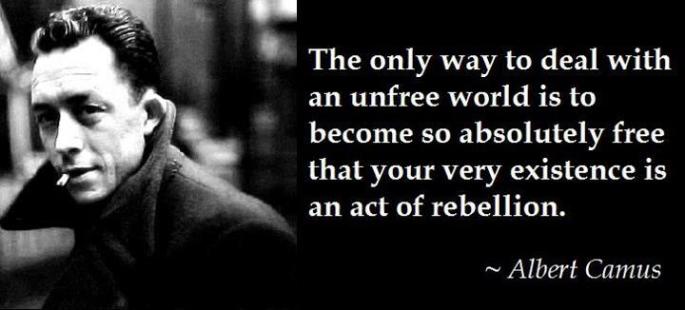
For help with anxiety or other problems: Mind, Saneline and The Samaritans have all helped me. For young people Healthy Minds is a great resource and @respectyourself is of great encouragement on twitter. Also there, @MHChat is for everyone, every Wednesday night; it is used by a diverse group of people. My favourite book about mental health: Depression. The Way Out Of Your Prison by Dorothy Rowe (Routledge, 2003). And, by the way, that’s Albert Camus in the picture. He was there, in my head, all the way through. x
These eighteen poems are, excepting the first one (which is already accepted for publication), in very draft form and are the basis of a poetry pamphlet I am currently calling Thalassa-Môr. It gets its title because, although it’s about countryside I know, difficult things that have happened, my family and other much loved people and events, I have also threaded through it elements from Greek literature and from Welsh. The title of the first poem is from The Odyssey; ‘Rhiannon’ lower down refers, albeit obliquely, to characters in the Mabinogion. I have also woven in stories from my grandmother and from other elderly storytellers whose auspices and provenance I couldn’t grasp as a child. Was I related to them? I wasn’t and am not exactly sure. The storyteller was the important thing. Anyway, these poems (plus some others) in a much more polished form will be going in different directions in the summer – so fingers crossed. NB: the layout that pops up on wordpress is not how they are set out in my ms, so some of the verses aren’t quite preserved and the left spine is uneven. This is an anomaly I haven’t fixed yet.
Do feel free to comment on the drafts at the bottom of the text. Anna x
1
‘Cast out, my broken comrades’
St Justinian at dawn; the boat,
Its clenched hull scowling,
As braced against the swell,
Collected errant figures – all
Adrift, so lost on land, and sad.
We reached out, emptied souls,
To Ramsey Sound; the island
Siren-called us, brought us home
To sea: to stay afloat a while
And find our shipwrecked selves.
It wasn’t in the landing of our craft,
Against the crashing deck of shore,
But somewhere in between the rock
And rock, that melancholy came to rest –
And tumbled down through navy depths
And we were free, unbroken: still.
This poem is published in Anthology of the Sea by The Emma Press, October, 2016.
2
‘My heart unbroken, then, by fish- frozen sea.’
‘Oh never fill your heart with trawlermen!’
My Nanny told, then told: ‘You want
a man with both feet on the ground –
a man with roughened nails, from
dirt and labour on the land,
not brined and drenched through by the Sea.’
But Nanny never knew the sound
of oilskin slipped on clover bank;
of danger in the stolen hull,
of silver, limned above your head,
while thwart hands toiled through the night,
and washed me up and brought me home.
I wouldn’t learn: I dreamed of pearls, full fathom five;
I sang of gales, the tang of salt,
the storied depths of sea and sea –
limb-frozen journeys, far from home
With yellow light on midnight crests.
But Nanny told, then told, ‘You want
a man with bone-dry shoes, inland;
your sailors leave you high and dry,
they catch and throw and pack in ice
the keenest heart that you can toss.’
But Nanny never knew the song
of siren journeys way out there,
Of labour stoked by heat and loss –
She didn’t feel the azure pull,
the mermaid kiss, the tongues that spoke;
she died a desiccated ideath, in clod
that choked, while primrose mocked.
Still, out at sea, I rocked and bobbed:
we drew the finest catch that day.
3
Madonna of the Cleddau
The sea coast was too far for you;
To keep inland was your advice,
Away from Jack Tar, foreign folk:
Stay cloistered on this estuary.
Madonna of the Cleddau, come:
Square jaw, dark eyes and, counterpoint,
Retroussé nose and powdered cheeks:
And born of earth, not briny downs.
You birthed eleven, stood back up,
With apron on and sleeves rolled high,
Delivered livestock, lipstick on,
With plaintive songs of field delight.
But, round the wall, the sea began,
Spoke not to you: you had no thought
To jump and best a warmer wave;
A voyage out was lost on you.
What did you care for them or theirs?
Madonna’s night world of the quay
Had supernatural force: the owls,
The rustle of the hawk, black elms,
The screech and call and elsewhere sound.
Such pale wings drew on navy sky
As you looked out across the flats
And thought that this was world enough,
The kelp, the wrack was only stench.
I’ve seen it now, your home; your hearth:
The summer quay was bunting dressed,
The village pub all polished up,
No gossip, snarling by the bar;
A ‘Country Living’ August snap,
All cleansed of snuff or pewter cup,
Sent gentry, as you might have said.
And rag and bone man, gone to dust.
Madonna of the Cleddau, mine:
I sing to you from farther shores:
I wish that you had gone to sea –
We could have basked there, you and I.
It never changed, waves’ thunderous moods
Could not be altered, made anew.
I look at Cresswell now and wish
The sea would roar and cry and break
The weeded walls, the altered beds,
Bring wrack and shells to grace the stones
Where mortar tidily restrains.
4
When did I
I went out early, tiger-clad, for bravery’s sake
To try the sea. Its bite was worse than mine –
It told harsh words and mumbles spat a briny sound
Of fury’s heart. And I was spent, so roared no more.
5
Returns a sea echo
Had I not been mute, still yet, as Milton might,
I should have cried to miss a mirror in every mind –
Not to have glimpsed the swallow, bright,
Such cresting clarion call and bravest hunter’s horn.
I might, I say, have wished to be alone,
Caressing so the dampening blossom now –
Finger tipped to velvet wings at dusk,
Unbound by duty, or amaranthine depths
To sit on quiet rosy evenings, darkness settling by
In bowing woods, with harebells pealing close.
For stillness made replete what things I saw –
And bosom sentiment was only that
Such contemplation of this hour was wasted not:
The honour was replete.
But very now, then up the churchyard path
A fox came, sharp; the beech tree whispered thanks
Thus honour was in being quiet,
Reverent in this storied landscape, still.
6
Myfanwy, I loved
Mfanwy, as you were: bay window, a side light and a black background.
Then as you were again: middle room – direct front light. I was specific.
Mfanwy – I was precise; exacting with the fall of dark and bright: I wrote it down.
Mfanwy, as I hoped you were. But you smiled and sailed away, sassy girl.
I sat for hours as the shadows fell, knowing what night must still portend: my craft.
I drew a nail across a pane and scratched your name, invisible to others as
the evening settled in. I knew that morning brought a monogram in window frost
for you to see and I to know: I showed you how its feathered lines and confidence
spoke truth to us – that you could stay. The frost had crept along the span
to show you how this foolish clot had said the most that could be said
and then I spoke – and ruined all. A foolish joke: my love; my word –
Mfanwy, stay. Mfanwy, do not sail away.
I tried to draw another length to keep you here: pellucid worlds for us to share,
yet how I knew what I had done. You cared not yet for crystal casts,
the shapes recorded day by day. The metaphor for heavenly plan
was lost for you in my thwart hands – and so I scratched and tried to show
a simple script, its blazon – you. I fell and fell and no-one knew.
Oh sassy girl, why should you stay or want a watcher of the skies,
a gabbling fool, like me? Why, no.
Mfanwy, stay. Mfanwy, do not sail away.
7
County Town
If I should fall, then say to me the reason clouds form as they are,
why ice should seed along a scratch, why I should love my six point star.
I do not know or care to see the smiles that fall in brazen line,
but innocence and clearest eye embolden me to make her mine.
I speak of love and quiet worlds, the county town on winter nights:
the sweets of honey bees, a view of ruby sky and amber lights –
of unctuous syrup mixed with snow, auroras made of rosy glow,
My Borealis blood-red sheen – if I should fall, then make me know.
When I am not and you are here, beholden to this dusty room,
be gentle with the tenuous forms of memory; do not grieve too soon.
Consider this – why should we be, ephemeral and urgent? How?
And speak to me with confidence, declaim for me on cliff or prow.
In nature’s fragile frame I see a world that lives beyond the hill,
Beyond the log pile, salt and shed; behind our eyes when we lie still.
And when I fall, then say to me you read its language, pure and keen –
And set my records on my desk and light my lamp: make them be seen.
8
‘Always there were uncles’ (Dylan Thomas, A Child’s Christmas in Wales)
I longed not to talk to him, the schoolmaster;
He was always old, even as a boy, Llewhellin.
His eyes blorted thick, his voice rasped:
Never a pretty thing was he.
But I misses him now, you see, that old man
Cresting the corners of the foxgloved lanes –
Standing at Walton West, scowling at the tankers
Bound for Milford from great bright places
He hadn’t seen and didn’t want.
And I misses the silent pouring of tea
And the picking of apples from his headland-wizened trees;
the storied estuary, century feuds and nodding campion.
And I cry when I scent, alone, the violet patch, dug up,
Where I found him. And he was gone, eyes closed and young.
9
Walton West
In this drear place, I see my family loved
In celandines and mugwort garlands drawn;
I do not not know what tears or mossy lies
They fought so hard to keep from being said
Llewhellins, thick and fast and tired and gone,
Their stories drawn in stone or footstep sand.
10
Still to be sad
In the old shop on the harbour walk I saw a note: ‘Be Mine:
were you that girl I saw on the sand, turning to face me
against the gale? I think you saw me and I want to know.’
It was there for weeks, that note, rusting in the sun,
And brushed by arms of the boys running from the beach
for ice cream and the papers for bored parents.
And weeks more it hung, unnoticed, torn;
down in shreds it was, a girl would never see.
But a girl had never seen. She’d been looking instead
over the shoulder of the keen bright boy
to the man who broke her heart: a challenge –
find me, save me. Do not let me now walk out into the sea.
But in the keening of the wind and
the straining of the gale, all turned away
And she was gone and the slips of note removed,
for something clean and tidy and not sad.
11
Druidstone Haven. A sonnet
We climbed the downward spiral of the trail
To best the shedding fingers of the cliff,
I’d promised you, oh love, I could not fail
I’d prove to you against our lovers’ tiff,
That there was treasure to be found that day –
Albescent moons to cradle in your hand –
Sea urchins fine, a little world to say:
Echinocardium, wanting to be grand.
But my world was not yours, you did not care
To hold the little lanterns in your palm –
The hollow globe within the greatest fair,
You did not care if such should come to harm.
So cracked the sea potato on the tide:
I knew, although I smiled, my love had died.
12
Grave bag
‘Girl, get the grave bag from by the back door!’
‘I’m doing it now, in a minute!’
‘But have you got there the water in the milk bottle,
the scrubber and the cloth and the scissors,
they’re rusty but will do to trim?’
‘Yes, yes, I see them now.’
‘But have you got them, have you? We musn’t forget
and mustn’t leave the bag at home and mustn’t take it
to the graves half full, is it done now, is it all and are you sure?’
‘Yes, I am sure.’
The bag was bundled and the car was roared and the dead were glad
of a well-kept stone and the brambles trimmed and no-one cursed,
like they did, all did, in life, and the door was keyed and the grave bag was refilled
and sat just as it should, and the life was endless not altered,
even in this loud new world.
13
Cariad.
Rounding the headland at St Brides and sighting the small churchyard,
Cariad, you were aware, weren’t you now, that things were changed that day?
You saw us with the girl, cousin by marriage, I think she was,
And all was well because she was not you. You were, weren’t you now,
The same age and the same beauty and the same dimension, even, roughly now,
And all so different because she was not you. And daddy said, I know he did,
‘Ah, my lovely girl, my cariad, look at your lovely golden hair
And your blue eyes and the light foot and a tumble of a laugh’ –
But that was not for you, but for your cousin, by marriage I think she was,
And she was fair and pretty and you with your welter of a laugh
And your thin voice and your pinched nose and you my shameless,
shameful little girl, mine but not mine and yapping now
as we rounded the headland at St Brides. Sing to the sailors, girl,
cry for the mermaids if you see them there, but in this dark world
where cliffs heap up and the boy drowns and the wrack fills,
think always that none of this cares for you, but for her, cariad.
14
Lewis, who went away
When I was a kid, Lewis took his own life.
I heard them say he took it, but where it went,
I couldn’t say or wasn’t told. Perhaps it had
been drained, in the sloop, with all his pints,
or thrown gladly off Stack Rocks with a shout
that he married well and was a man they liked,
but I don’t know. For once, though I was very young,
I saw a look from out the corner of his eye as he shipped
off, went laughing with the pot boys and his girl:
that look it said, I think, that Lewis wanted rescuing,
but no-one came, as the sea foam danced in Cardigan Bay.
15
Auger
The Auger shell, unbroken, in the palm,
still yet, such tenor of this hour upon this tide,
I wait at Nolton, looking out to sea:
you do not come. I nurse the shell,
its whorls and tidy chambers tell
of secrets and of things I cannot know;
the grains of sand, or filament of carapace
swept up inside its little maze,
its rooms, its tidy cap, once came from elsewhere,
elsewhere on this tide, I’ll never know. And you,
I wait for, still, looking out to sea. I hear you laugh
and cannot say from where it came, but seabirds circle low.
I throw the shell where anemone and spider crab
have made their home – more life reclaims it now,
as your laugh is lost to me, in warm thrift and gorse
and the tenor of this hour upon the tide.
16
Rhiannon
My mother taught at Wiston school,
Her hands were lithe, her mind so sharp,
Her friend Rhiannon worshipped her
And plucked her name upon the harp
Which sat all gold, in sight of all,
Rhiannon’s talons told mother’s fall –
She plucked a death upon the strings,
Her dainty nails scratched their goal:
‘Your mother will have feet, not wings
And with their clay, they’ll crush her soul –
Oh read The Mabinogion, dear,
You pretty pretty little child –
For you shall be my daughter fair,
my son Avaggdu’s ugly – wild –
the thick and thwart upon his brow
why should she have while I’ve not got?
Your mother taught at Wiston school
and so I tell you, she shall not.’
She plucked and plucked and screamed her rage
now mother’s clad in primrose dell,
But I can’t go and see her now,
Rhiannon keeps me in a cage
And sings to me of dulcet love
And all the things I cannot gauge:
Avaggdu cries for he’s not loved
And spits upon upon sweet mother’s grave.
17
The Famished House
‘Around here, the trees suck air and, at night,
when the last shriek of the plump and pretty-breasted curlew
s drawn from its throat, and when the strand-line treasure
is dulled and shredded against the rock, even in fair weather,
well then: that is the time that the houses take their fill.’
‘Nanny, is it true?’ ‘ Oh yes. Around here, when the moss
spawns bad, it creeps across your foot if you slowly move,
so be sure to move quite fast, when the twilight stalks,
then that is the time that the houses take their fill.’
‘Nanny, is it true?’ ‘Oh yes. When the jewel sky
and the lapping wing, have beat their very blood
into the hour, take heed; the tidiest stones
we built such with, will stretch up so to bark at silly men,
the silliest from away, for we shall know
what is to come, as groaning, crafted stone leans in
to kiss a sleeping face and staunch, in wild rebellion, dear,
the men that wrest it proudly from the ground.’
18
Slebech Forest
‘Today we will go inland dear, to see the rhododendron bloom,
Away from sea scent, sunset shell; away from me, away from you.’
We travelled for hours on little tracks, their way being marked with showy prime,
It was, at first, of some delight, but then my love spoke of his crime:
‘So stay here, love, forever held, unless you scent the estuary,
And I fly high, to England bold, away from you, away from me.’
Ah dear, you underestimate my knowledge of this mazèd land,
You did not hear the laughing breeze, dead mammy’s come and with her hand
She’ll pen you up, beside the Rhos, and I will run forever free,
I’ll not stay here, forever held, not stay with you but live for me –
An orient boat will rescue me, blown on dead daddy’s pretty curse
And rhododendron casket blooms will strip your life and end my verse.
 Anna Vaught Writes - Dr Anna Vaught: teacher, mentor, author, campaigner