Day 3 of my alphabet – a gift for you, all about looking after ourselves. The letter C – for comfort

A New Writing Competition

Patrician Press

The Patrician Press Short Story and Poetry Prize

We are pleased to announce that the first ever Patrician Press Prize is now open for submissions


Age 18 upwards
Closes 31 March 2016
Results 30 June 2016
Maximum length  Short stories and poems can be any length up to 2,500 words.

Judges Anna Johnson, editor; Emma Kittle-Pey, writer; Petra McQueen, writer and lecturer in Creative Writing at University of Essex; Joceline Bury, journalist.

Prizes

First – One week stay at writer’s retreat in Italy* and publication of story or poem in Patrician Press Anthology

Second – Full set of Patrician Press titles and publication of story or poem in Patrician Press Anthology

Third – Patrician Press title of your choice and publication of story or poem in Patrician Press Anthology

The winning entries will be chosen from a shortlist of six stories and poems. All six entries will be published in the anthology.

The competition is free

How to Enter On-line

http://www.patricianpress.com/submissions/

Please follow the instructions. Under ‘genre’ insert ‘SHORT STORY/POEM PRIZE’.

MAKE SURE YOUR NAME AND CONTACT DETAILS ARE NOT ON THE STORY or POEM. (Judging is done anonymously.) Your story or poem and name are linked automatically when you enter.

Stories will not be returned.

Rules for Short Story and Poetry Prize

  • Entry is online only via Patrician Press Submissions page.
  • Only one entry per person.
  • The competition is open to writers of any nationality writing in English.
  • The theme is based on ‘Refugees and Peace-Seekers’.

“No one leaves home unless home is the mouth of a shark.” Warsan Shire, Teaching My Mother How to Give Birth

“When the power of love overcomes the love of power the world will know peace.” Jimi Hendrix

(Stories and poems can be light-hearted in approach, reflecting the subjects of refugees or peace, or both.)

  • The winning stories or poems must not have been published previously.
  • Patrician Press will hold electronic and paperback publishing rights for a period of three months after which the electronic and paperback publishing rights revert to the author.
  • Notification of receipt of entry will be by email.
  • The judges’ verdict is final. No correspondence will be entered into.
  • Stories or poems cannot be altered or substituted once they have been entered.
  • Judging is anonymous. Name and contact details must not appear on the stories or poems, but inserted into the boxes on submissions form.
  • Entry is taken as acceptance of these rules.


* Airfare to writer’s retreat is not included. Pick-up from airport and travel inside Italy is included.

——————————————————————————

Patricia Borlenghi who runs Patrician Press is severely hearing impaired and tries to encourage writers with disabilities as much as possible.

UPDATES ON KILLING HAPLESS ALLY

A few updates. My interview on friendship with the excellent journalist and broadcaster Wersha Bharadwa is out now in this month’s ‘At Home’magazine (and published with Wersha’s kind consent on http://www.patrician.com), my ‘Wordy Wednesday’ interview is here…

Wordy Wednesday with Anna Vaughttattooedmummy.co.uk/2015/12/wordy-…@BookwormVaught

…I was interviewed by ‘Bella’ magazine yesterday and it’s all go. The fine YA author, Alex Campbell (Land – currently nominated for the Carnegie Medal – and Cloud Nine), has also written something for the back of my book..

“Anna Vaught writes prose that is both tender and volatile to get to the heart of a difficult subject. Beautifully crafted, insightful and affirming (but most of all, laugh-out-loud funny), Alison’s journey to find mental well-being will speak to many out there who have faced anxiety and depression. A must-read that will provoke thought, debate, as well as tears of laughter.”


Have a look at www. patrician.com for a new writing competition, too!


Alas, no – I cannot offer you Albert, but look within the book and you will find him: a vital presence – and with a motley crew alongside him.

Killing Hapless Ally will be with you on March the third! This novel will be published with Patrician Press and you can order it through any bookshop or buy online at Amazon, GB Books, Waterstones and so on. I will be talking about the book and doing signed copies at its launch at Mr B’s Bookshop on March the third. Meanwhile, I have been in ‘At Home’ magazine talking about friendship and its ebbs and flows(viz a viz Killing Hapless Ally),  I am looking forward to my first poetry publication with The Emma Press next year, I am completing a pamphlet and working on The Next One.

As you see below, the award-winning mental health journalist, Martha Roberts, has written in praise of Killing Hapless Ally and  I hope that when the book comes out, readers will enjoy its rattling tale as well as find comfort in its pages. It is a work of fiction, but, as I write in the foreword, very much based on experiences in my own life. There is still so much stigma surrounding mental health and mental illness – neither of the terms is ideal – but I have tried to tackle it head on in the book as I saw it and as I experienced it.

So here’s the back cover of the book.

Killing Hapless Ally is a tale of an individual grappling for sanity and identity; a black comedy in which we discover how Alison, its curious protagonist, conceived in childhood an alter ego called ‘Hapless Ally’ in order to present a different, more palatable version of herself to her family and to the world beyond. Ominously, the alter ego began to develop autonomy. You learn how Alison had to deal with that: she had a lot of help from a varied catalogue of imaginary friends! The book is about serious matters: fear, confusion, dark days of depression and breakdowns. It carries with it a timely message to anyone poleaxed by depression and associated problems – or any reader interested in the windings of such things. You can, like Alison, survive and prevail. Ah, but how would you do it? If you had to – to survive – would you kill for it? Now that is an interesting question.

‘Anna’s story of Killing Hapless Ally is a heart-rending book that covers the subject of depression in a brilliantly funny way – no mean feat. With every chapter I found myself willing Alison to thrive and prosper as the feisty and incisive survivor that she is. Go, Alison!’
Martha Roberts, author, columnist for Psychologies magazine and award-winning mental health journalist.


Cover illustration: © Charlie JohnsonkillinghaplessallycoverISBN 978-0-9932388-4-0]

A quick, creepy write for Halloween.

A light drizzle settled in and, as Berenson walked home from an unremarkable job in the city, the darkness began to fall over London in November.
From office to tube and from tube to the beginning of his walk home, he was content enough. Even with the grey evening, the drizzle was refreshing on the skin after a day in the office. He observed familiar faces on his way, nods of acknowledgement and, to a certain extent, he fancied, of understanding. The day had gone tolerably well.
Walking up the final small spiral staircase from the tube station, though, Berenson was struck with an odd feeling: of the familiar being just a little off beam. He couldn’t put a finger on it, but it made him shudder. Thinking carefully, the white tiles looked perhaps a little yellowing; the steps altogether dustier. Now and then, he felt someone brush against his shoulder, but yet he had no sense of someone quite so close to him as he made the final ascent to the street. Again, he shuddered.
Walking in the direction of home, he stepped first into the everyday sight of a London street, with its selection of shops. He bought an evening newspaper, rolled it up and put it under his arm. Again, the shops looked a little different. There was an unseemly and garish quality to the lighting and the bright displays of goods, even in the small newsagents where he stopped every evening. He had never noticed that before, always enjoying the convivial warmth of the shops and shopkeepers as he walked home. He reached the end of the road, where shops began to give way to the residential streets. Berenson had an odd feeling – almost like the warmth of someone’s breath on his back. He shook it off. “Maybe,” he thought “I have one of my heads coming on. I’ve been working pretty hard ” But the feeling did not abate: it grew stronger and more disconcerting, accompanied with an inchoate understanding of something slinking his way.
Rounding the corner into his own street, it occurred to Berenson that he had yet to turn round. To have done so would have been to give credence to what he thought a foolish sensation. So he walked on. But, as he did so, he was conscious of the increasing closeness of another individual and, also, of footsteps behind him. Yet, when he stopped, so did the sensation and the hoof taps. It was true: they did sound very like a shod horse striking a road. Moving on again, walking more quickly, the steps and the individual kept pace with him. Looking around, he had the bizarre sensation that he was seeing everything as it always was – but through a glass darkly. And that, if he were to call out, no sound would issue forth.
Walk on, walk on. Did he hear a laugh behind him? Was the breathing full and throaty? And did the man behind him identify himself as Berenson when, unable to bear it any more, Berenson looked back?
Daylight saw Berenson travelling, as usual, down a pleasant city street and past shops doing brisk trade and on the London underground. All was well. But tonight a story would appear in his newspaper about the diligent, well respected man, found cold and dead in his street last night. And the man who cut him down would, while there was time, sit in Berenson’s favourite chair and tweak at what we know of our everyday familiar world. He would shuffle off his steel-tapped shoes, brush a little lint from his fine dark suit. And he would laugh. And soon he might come for you.

A Tale of a Twitter troll. And me.

Earlier this year, I began receiving horrible messages on twitter. This is by no means unique; twitter trolls are legion. People very much in the public domain may receive many perverse and violent-sounding messages. The journalist Caitlin Moran has said that, once she publishes a feature, she may receive hundreds of messages an hour, threatening harm to her; speaking of dreadful things. Twitter itself, however, has admitted that it ‘sucks’ at managing the issue. So what happened to me? It’s not in the same league as someone much more in the public domain, but here’s what happened. I want to write about what I know, how it changed me and what I might pass on.
Twitter is great: vibrant; democratic. You can reach out through it. If you have a problem, you can find help quickly, as it houses, for example, many support groups for those with mental health issues. It can be a huge support to people and it is a vital networking tool. For me, as I seek to establish myself as a novelist, its links with publishers and other writers are brilliant; as a teacher, I can get fresh information fast: from a philosopher or from an exam board!
I am a mother of three, an English teacher and author with a debut novel out in February and an emerging portfolio of other works. But I am also a campaigner. I write to people and pipe up about mental health provision a great deal but – more pertinent to what happened on twitter – I try to change things for the better in our community. Not because I wish to hector or be belligerent; not because I think I am in any way superior in my views to another human being, or because my way is right. But because we can see pressing issues all around us where I live – potential private development on sites that have been used as play areas for generations of children; busy roads by primary schools without low-speed limits and entirely without crossing. I also try to respond to the things others sometimes tell me if they are upset. Things come to me through the work I do and I probably know quite a lot of people locally – so I talk to them. And on a number of occasions, visitors to our town and a few older members of our community had told me that they felt there was a lot of litter about and that it made them feel sad. That was enough for me. I tried to do something about it. These days, if you want to campaign, twitter is a valuable thing. So I went to work on the litter issue and one of the things I did was to get information on twitter, some of it pertinent to local business.
That was Thursday.
On Saturday the messages began. They were repeated many times, sent from accounts all over the world. My address was published at the top of each one. I was told to take down my account or ‘we will come for you.’ The tweets described how I attacked local business.’
So you see, there was immediately something rather geo-specific about this. A friend said, ‘I expect this is an anonymous troll.’ Well, to me, that didn’t stack up.
The tweets kept rolling in from all over the world.
My address and ‘We will come for you. Close your twitter account.’
I sat on this for a day. I was physically sick. That was the intention, wasn’t it? But did I take my twitter account down? No, I did not. I don’t think that responding to threat with a fearful response is a good thing. It encourages a bully, a narcissist, an angry person to do it to someone else. So I didn’t close my account as the threats rolled in, because to have the person behind this get the better of me and, potentially, go on to threaten someone more vulnerable was unconscionable to me.
Later that day, a new wave of nasty messages began, still with my home address at the top. Threats to me when I was out in my home town – referred to by its abbreviated name, which I’d noted local folk only tend to use – were forcefully communicated. I was instructed to ‘look behind’ me and promised that I would be harmed.
At this point, I contacted twitter – my husband having taken screen shots of everything – to start closing down accounts where we could. Twitter would not block the accounts from the first wave, they blocked some of the accounts from the second wave, but not all. And it’s at this point that I realise I have to explain, just in case, that the threat is not from the accounts sending out the tweets. If you are ever the victim of trolling where the same messages are sent from multiple accounts, then you’re likely receiving them from ghost accounts, which are just really platforms through which those courting a social media following, for whatever reason, retweet a message they are given – perhaps through a platform such as one that promises things like this:
‘…a network that will help you grow your social presence. We allow you to look and choose who you want to like/subscribe/follow/view and skip those who you are not interested in.
… increase Facebook Likes, Facebook Share, Facebook Followers, Facebook Post Likes, Facebook Post Share, Google+ Circles, Google+ Post Share, YouTube Subscribe, YouTube Video Likes, YouTube Video Favorites, YouTube Views, Twitter Followers, Twitter Tweets, Twitter reTweets, Twitter Favorites, Ask.fm Likes, VK Page Followers, VK Group Join, MySpace Friends, Instagram Followers, Instagram Photo Likes, Pinterest Followers, Pinterest rePins, Pinterest Likes, Reverbnation Fans, SoundCloud Followers, SoundCloud Music Listening, StumbleUpon Followers and WebSite Hits (autosurf).
We provide the widest and the most spacious choice of social media exchange in today’s world of limitless and infinite internet possibilities. Here are represented all the influential and powerful social networks with their numerous features.’
 Note the words, ‘Social Media Exchange.’ There are sites out there where, for five quid or in exchange for retweeting a bit of publicity for someone (bartering), you can send out a message and remain anonymous: you’re hiding behind hundreds of accounts. These sites care nothing for you; it’s possible that the twitter account holders don’t even know what’s being sent from their account if it’s managed by someone else. We know that, because we contacted one; she was hesitant, but helpful. Trolls scare people, after all.
We informed the police with the second wave. Both my husband and I took some time explaining it to the non-urgent line. Social media crime is in its infancy. If you ring up the police, you may be met with a measure of reassurance – as in, the ones that make the threats don’t generally follow through – but also a frank statement that they are limited in what they can do. But we passed the screen shots and – this is the bit I haven’t mentioned yet – slew of circumstantial evidence we had gathered – to the police and they handed it to the local constabulary.
Things went a little quiet, but I could feel how badly affected I was. I was sick again. I would go  to sleep and wake with a start. I kept that up for months.
Then the threats escalated further. An anonymous person publishing my home address, all around the world, speaking of the harm that would come to me; writing about local business; offering geo-specific fear. And then the individual said they would take my boys.
‘Close your twitter account or be careful who picks your son up from school.’
Back to the police. At this point, twitter blocked the senders; we had no choice but to inform the Heads of my elder boys’ schools and my youngest’s nursery. The holiday had just started, but schools, receiving my email, rang me anyway. Because with safeguarding you have to be all in. ‘Generally’, as I was told – and as I said above – those who make the threats don’t carry them out. When we are caring for our young, that’s not quite enough, is it? And we now know that a crime had definitely been committed: harassment. More than three of these messages constitutes it. I’d have added ‘malicious intent’ too.
But the police, who then visited me, speaking to the two older boys while they were with me, had to say that there was nothing they could do. They cannot caution without proof and proof is not the same as evidence. Within a few days, we had assembled what follows….
All the screenshots of the threats. There were many. That took a long time, but my husband is a determined man.
Copies of any of my interaction on twitter with a local business (there was only one)
Twitter profile material relevant to the above – such as that championing those against people who ‘moan’ on twitter
Sub tweets from a local account that, unless I was being very dim, appeared to be mocking the fact that I had had my children threatened: we had made some local enquiries. We had to, because of the children.
A letter to the sector commander of our county police, sent by our MP. The sector commander stated that this was beyond the police’s control because these were threats ‘from anonymous accounts.’ That was a misunderstanding of the origin.
A conversation with my husband’s congressman (my children are dual UK/US citizens), who attempted to press twitter to help us. They would not.
Everything you do digitally has, as I understand it, a digital footprint. But, if a person wants to hide, it is difficult to find them. Neither twitter nor the third-party site which, we were pretty confident, had been the source of the original message, would co-operate. I could have tried to push this through a civil court or gone to the press, but I decided I did not want the exposure. This week, I realised we could go no further and yet…….
I have stopped checking the doors during the night
I am not being sick
I didn’t walk alone in my home town for three months. Now I do.
How I feel about my neighbourhood has been compromised. I know that is sad, but I could say that a period of reflection has brought about greater ties with the wider world. I actually think that my troll, because he caused me grief – and I mean that in terms of loss – also gave me a ball of energy to burn. I turned it toward my writing and putting it out there: I got a publisher for my debut novel, guest blogs, a brief twitter conversation on the troll subject and twitter’s inefficiency on it with Jon Ronson (what can I say? I’ve always loved him) and  had a second publisher I had set my heart on pick up a poem. It was a poem about change – through pain – told through the metaphor of a sea journey. All very Homeric. But that’s what I was going through: a sea change.
I had approached the task of establishing a forensic link between our lovely local Wiltshire constabulary, the town mayor,
Virginia and Washington with considerable verve.
AND
The litter looked a bit better.
So hey, Mr Troll. I am going no further. Got to consign you to the past, while I’ve made everyone I can aware of what happened. This year, a few things have ended or changed exponentially for me. No, I don’t exactly feel safe in my own community any more – that was your intention, I imagine. It’s a sad thing. I’m not sure if it will change back. But on the other hand, by the time I left my teens, I was alone in the world and I couldn’t be scared because there was no time. I’ve been like that, ever since. I’ve been so ill; I’ve survived. Fear and sadness don’t stop me because I looked them in the face and found I was still standing.  You must be sad, too, to threaten me; to speak of my children as you do.  To be so angry, but fearful enough to hide. And you should be helped.
But there is fire in my belly and my voice will not be stilled.
Do not do this to anyone else.

Some more publication plus MacNeice and Kavanagh

Ramsey Sound, Pembrokeshire

I am very excited to say that my work is being included in a poetry anthology published by the Emma Press. Here they are

http://theemmapress.com/

I wrote a series of poems called Pembrokeshire Poems and they picked one called ‘Cast out my broken comrades’, the title of which draws on Homer and also a poem (which itself does the same) by Louis MacNeice called ‘Thalassa.’ I am so pleased as I didn’t expect to achieve publication so soon.

I’d been re-reading Louis MacNeice prior to starting these Sea poems; he is a great favourite of mine and he always has been. MacNeice appears briefly in my first novel Killing Hapless Ally (Patrician, February 2016) and there is a refrain from his poem ‘Meeting Point’ in the novel, too. If you read the book, you’ll see WHY and HOW ‘time is away’ and also (I quote from Patrick Kavanagh’s poem, ‘Prelude’ – another refrain) why ‘the millstone has become a star’ – the epigraph to the novel, a refrain and there at close of day. (I was granted permission from literary estates for these at no charge – very generous.)

For me, the lines already in my head and the lines I have yet to read, will always be salve and solution.

The poem itself decribes a dawn voyage across Ramsey Sound to the island; the voyage itself is both literal and figurative – as I expect you guessed. It is about being broken, being lost and experiencing the first moments of healing. A ‘sea-change’ you might say, quoting Ariel in Shakespeare’s ‘The Tempest’.

Do have a look at The Emma Press. They are a dynamic lot – much going on – and their Anthology of Motherhood contains some stunning writing. You can buy it through the site – or borrow my copy!

By the way, I have written (I’m aware this sounds reckless) a chapter book to enter for The Bath Children’s Novel Award (I hadn’t even told my husband I did it), but I’m still deliberating whether it’s too rough and ready to submit.

But back to the poem. The Emma Press Anthology of the Sea will be published in October, 2016.

The picture of Ramsey Sound, above, is from the Pembrokeshire South East Energy Group website.

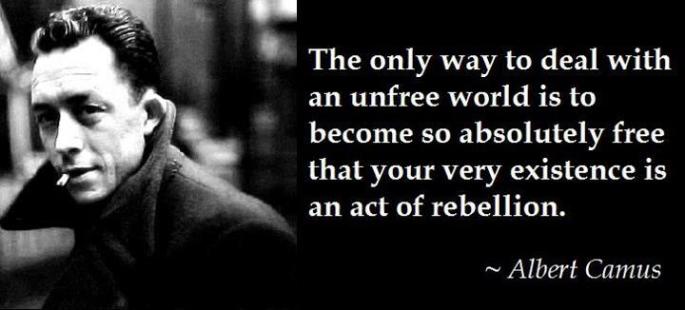
An extract – featuring Albert Camus – from Killing Hapless Ally. This Chapter is called The Mis-education of Alison.

Pre-order from 3rd of February, folks! The ISBN is 978-0-9932388-6-4 and it’s published by the wonderful independent press, Patrician. Killing Hapless Ally is not a book for everyone. It’s densely packed with idea and allusion; it’s dark and (I hope!) comic. But if you like it, take it to your heart and that will make me so happy. It is fiction, but within it, there lies a distillation of what I know, what I have found out and what I have been through. It is about how mental illness takes hold – how it can settle in so young – and about imaginative ways to fight it. And that, lovely readers, is all me. x

NB: there may still be some editorial changes to this copy before I bid it goodbye in a few weeks.

THE FOLLOWING EXTRACT CONTAINS EXPLETIVES. Actually, there’s a hefty amount of creative swearing at various places in this book.

Not for this homme a lie down in the afternoon, but a manly growl after lunch, some Gitanes and a marc. Step forward Albert Camus and also the story of becoming an existentialist on a campsite. Not Albert; oh no, no, no: he was far too cool to be seen in a Fucking Caravan. It was Alison, trying to translate the world into something that made sense.

We have already shared fateful tales of The Fucking Caravan, of the entrapment between two alder trees and, on the same trip, tales of two blacksmiths. However, on that same ‘holiday’, parked up by the Seine and sitting under the willows for days (with her parents somewhere else; they didn’t say) Alison began a roaring and extraordinary affair with Camus. It was a reading summer, between the two sixth form years. All around was the sense that people were dropping like flies and the deaths of Dad and Santa Maria must surely be imminent; she just hoped, ever practical, they didn’t happen when the two were out in the car, or maybe driving on to the cross-channel ferry, with everyone hooting furiously behind them. But the reading: for days on end by the river: Sartre’s Nausea, Genet’s The Thief, and, best of all, Camus’s The Plague, The Fall, The Outsider and Selected Essays and Notebooks. Also, at speed on the journey home, Simone de Beauvoir’s The Force of Circumstance and, cheerily, A Very Easy Death. When she got home, Alison devoured Gide’s Straight is the Gate and Fruits of the Earth: ‘Nathaniel—I will teach you fervour!’ Fervour: Holy Fuck—what was fervour? What was lust for life? Were those things somewhere in the unknowable distance, just visible beyond the bacon grease of The Fucking Caravan? She was intoxicated: dislocated entirely from her surroundings. The dislocation did not provide a new or unfamiliar sensation, but this kind of dislocation was one in which she was on fire and in splendid company.

‘Come. Come away with me now. Tonight!’ said Albert Camus.

Now, one could dwell on the literary qualities of Sartre and Simone de Beauvoir, but the most impressive thing for an adolescent Alison (she whose constant companions to date had been imaginary Swedes in a crawl space) was the sense she gained of Sartre and de Beauvoir’s love affair; that they wrote and argued and shared and, of course, smoked (like Helen) in the cool way. And when de Beauvoir wrote about her love affair with Nelson Algren—not to mention sharing bricks (bricks: Ooh la la!) of raspberry ice cream with him—Alison had a peculiar light headed and heavy hearted sensation. It was, we would have to say, the first knowledge of the erotic. And it hurt, because it didn’t exist in any part of the real world, where there was just getting off and, for some girls, an early, clumsy, grasping fuck. When Simone de Beauvoir wrote of their ‘contingent lovers’; of love affairs, known about by both but clearly allowable and part of happen-stance rather than a dedication for a lifetime, it sounded both painful and delicious. How entirely entrancing for the teenage Alison that de Beauvoir and Sartre wrote and expressed an intensely creative life to one another. This was something Alison could never quite get out of her head. And when she tried and failed to engage something which might look like it, the stone dropped in her heart and she was scared to open her hand in case the frightening thought was there, pressed into the palm, waiting to open. And she was scared of being herself: Just Alison (as Denis the Lusty Blacksmith had it), while in her heart remained the appalling leaden feeling and the acute sense of being separate; weird, possibly a killer; not inclined to the magazines and spontaneity of her female peers: missing the point always. Wrong and Weird Kid. She willed herself to live on in a way that was meaningful and hoped that she would find people to discuss these feelings with; that she could know someone who understood about absurdity, existence precedes essence or the frightening experience Sartre’s Roquentin has when, in Nausea, he touches a door handle and comes face to face with jarring, sickening anguish: that anguish lived alongside Alison permanently. At five, it had started somewhere after Saturday morning cartoons, as the day unfurled; at sixteen it began after Weetabix and before the first application of lip-gloss.

‘This I understand: it is when the scenery collapses,’ said Camus.

He made it sound exciting in his low tone. But it wasn’t in real terms: at least, not yet; instead, it was terrifying and yet Alison had a timorous sense that from that terror came only a beginning. That definitely made sense. Good god: intellectual heat; the erotic in its most subtle form; a notion of how to live with hope, when God quite clearly does not exist and we must travel to the frontiers of our anxiety to understand where to start. Alison was not asking much in a man, then.

Ah—but one ready day along came Albert, ready for action. If you have ever read his peculiar, flat, sparkling, cold story of Patrice in The Outsider, then there is little to express. But if not, imagine a wandering, solitary individual, not inclined or feeling the pressure to act as expected. Not cruel, but mercenary because appetitive; plainly erotic in responding to his needs as and when they push forward, articulate of who and what he is and yet without what would feel like morality to us. He did not cry when his mother died; he shot a man on the beach and did not express regret, only annoyance. For the teenage girl, it hit a nerve. The description Camus had of his protagonist as a solitary and wandering individual; as somebody entirely alone and on the edges of society, now, that was the truest description of her to date. It was—and there is no other way to say this—a first orgasm. Not only with the plainness of the character and Camus’s prose, which Alison gamely attempted in both French and English, but also because of the man. Let us describe him. Alison had to get over Mersault first, a man both in love with the world and separate from it. Camus told her of how his protagonist was inspired by a stubborn passion, for the absolute and for truth. His truth remained negative truth, but it had its own beauty and without it there could be no adroit comprehension of ourselves and of the world; no self containment. Mersault’s life was that of a foreigner—a stranger—to the society in which he lived, and he wandered about on the fringe, in the shadows of others’ lives: plain, but deeply sensual. Such descriptions made Mersault enormously attractive to Alison and made her fall more for the man who wrote him into being. Such a telling of the outsider, the wandering foreigner living and breathing a negative truth, pierced and had a difficult heat for her because, of course, that was Alison. We could say she was Weird Kid—plenty did and probably still do—but l’étrangère would sound altogether more arousing, non?

Alison had photocopied a picture of Camus: it was of him, apparently sitting on a rather lopsided sofa, and leaning forward with his hands tensed, his mouth slightly open, his eyebrows raised and his trousers showing his socks as he inclined towards a co-combatant to advance his argument. He was so fabulously French; so fabulously exotic because he came from Algeria, that he carried off the sock thing with élan; socks were not normally a detail of erotic piquancy. Camus might have been describing how brilliant it was that William Faulkner had pulled off the language of high tragedy; that a man from Mississippi could find language that was simple enough to be our own and lofty enough to be tragic. Or perhaps he was dictating something for the Resistance magazine, Combat, of which he was the editor. But, to a teenage girl, under his spell he was also evincing arguments for,‘Come away with me.’

And, ‘Let me show you.’

Or, ‘Let me show you how to live in the face of despair. Sit on my knee and we will begin.’

And, occasionally, when the Oran sun roused his temper, ‘Come here now and stand against this wall. I will take you.’

Was this what Helen had meant, gifting Alison the Camus as she lay on her Cyclamen Terrace deathbed? It was a jolly long way from a few drunken fumbles in the dark when they—the boykind—mistook her for someone else. Camus would have taken a bowie knife from his pocket and cut her out of her clothes, grazing her skin and eliciting just a little blood as he went. Later, he would lick the drop of blood off the knife like a wolf.

Albert’s cadences were delicious: he was declaiming phrases of profound, shattering erotic power to Alison’s ear. And by God he had enough style to be vulgar, if he wanted. Camus had a history of manly pursuits, too: goalie for Algiers; a fine swimmer and athlete. She had a sense of his being a consummate man. Funny; brave; a demon in the bedroom—if you ever got that far, because what are walls, floors and furniture for? And, unlike JK, he could have built a wall or changed a tyre. On the occasions when Alison went to other girls’ bedrooms, she saw they had pictures of The Cure, or Bono, when he was ragged, young and angry. She, meanwhile, had a picture of Albert Camus next to her desk. People said, ‘Who’s that?’ and she said, ‘My godfather. The notion felt entirely, naughtily fitting, for the Camus books, en Français, that Alison possessed had been bequeathed to her, as you learned earlier, by her godmother Helen, studying Camus at The Sorbonne. Perhaps Helen had been similarly intoxicated (which made the Terry the Fat Controller, the unexamined life, Friday-pie thing even more depressing). So the honorific chimed as fitting. Plus it felt like Albert leaned over Hapless Ally in a proprietary and manly style. L’Étranger was inscribed with the words “Helen Griffiths, Paris, le 19 Janviér 1962” and Alison had always hoped that, in leaving France for Terry, his mother’s pie and a new life in Tyneside, Helen was able to say, like Camus’s protagonist at the point of death, that she knew she had been happy. She hoped it was like this for Helen especially when the morphine gave her respite from pain and the unexamined life downstairs, punctuated by the sickening puffs of air freshener from the Cyclamen Terrace plug-ins.

Now, all those years it never mattered to Alison that Camus had been dead ten years before she was born: he was there on her wall now.

Godfather. Most louche, brilliant, gorgeous godfather.

She saw in his Notebooks that he wrote, ‘I loved my mother with despair. I have always loved her with despair.’ Good God. He even understood that. It was exactly how she felt about Santa Maria. And by God (although He is Dead if He ever Existed) Albert was brave: he would stand in the face of despair and say that now he was free.

Ah: the growingupsexthing. Alison had hopeless expectations, really, for while Camus smouldered away behind her closed eyes, real life was, shall we say, more a damp inconsequential thing than a smoulder. There was Johnny in the barn. Always, ‘Let’s go to the barn,’ a bunk up against a bale: no use there expecting conversations about Proust. She asked him about books and he said, ‘Why would anyone want to read boring books?’ But in school, there was an important dalliance with D.H. Lawrence. It was Sons and Lovers and she remembered mostly Paul Morel’s loving: not the bit which was like a communion (with Miriam) but the bit which was ‘too near a path’ with rather racier Clara. The evocation of Paul’s mother, however, as he drifts back to her—and drifts to his own future death (as Lawrence himself had it in his notes on the text), now that was a theme best avoided during these delicate years. Besides which, no-one would have got it because at that time boys just wanted to get you drunk and feel you up in a dark room when the parents are away. Only in reality, they were feeling up someone else. Like Heroic Alice. Oh yeah: Heroic was still around; jiggly tits, cool-thriving and diving and looking on her hapless (again, ironic, though note lower case) counterpart with scorn. She had the best clothes and hair; told the kind of jokes boys liked. When she moved upstairs, the party moved with her, while Alison stood downstairs thinking about existentialism and, ‘I’m a misfit and nobody fancies me.’ Alison was definitely Weird Kid. Good job she had Albert

WRITING…READING…BIBLIOGRAPHY

WRITING

So, my manuscript has gone back and I have a little time (ha!) to work on the chapter book I’m submitting for both Bath Children’s Novel award and Chicken House/The Times competition. I have also discussed writing a YA novel with someone rather wonderful I met through discussions of all sorts (including writing books) on twitter. I also, chancing my arm, submitted feature pitches to ‘Mslexia’ and ‘The Atlantic’ – both were about mental health and writing.

READING

I read – as I tweeted to him – the whole of James Dawson’s This Book is Gay in one chomp. As an exploration of sexuality FULL STOP this is an excellent book. It’s comprehensive, funny and wise; I hope it will get used in PSHE in schools – and I say this with my day job hat on: as an English teacher and one who used, like James, to teach PSHE. PSHE is the starting point, I think, for teachers: do it well and students may come and find you at other times to talk things over. For the digital natives, there is a great deal of LGTB* support online – but this book is an essential for bookshelves: for young people, for their teachers and for their parents. I have already looked at the book with one of my boys: with my almost twelve year old because he saw the cover and was, of course, intrigued (my fourteen year old saw it and ran away. Make that two copies for this household  – I’ll leave it by his bedroom door).

Other reading…I’ve almost finished John Carey’s The Violent Effigy, his fine exploration of themes, images and symbols in the work of Charles Dickens, just started Ian McEwan’s The Children Act, which I think I will stay up late reading tonight as I am already, as you could predict, hooked by its first characters; I want to know what the dilemmas are; I want to know about the first protagonist and her husband and what the consequence will be of his so unapolagetically announcing an affair with Melanie who wears heavy amber beads…I want to know about the legal papers in a fan on the floor and about the title of the book and whether I am to read ‘act’ as both noun and verb.

And it has been the morning of the em dash, of writing to Catherine Camus, daughter of Albert, for literary permissions and of doing the draft bibliography of my debut novel, Killing Hapless Ally. Why the bibliography? The book is about, shall we say, unusual methods of staying sane; of being less alone; of not being terrified in a home of desolate proportions. Bound up with that is reading and the novel does refer to and quote a good number of books. Some are in the acknowledgements section, which houses Kavanagh, Camus, Larkin, Plath, Auden and Dorothy Rowe. Here are the (draft) others!

BIBLIOGRAPHY

I have referred to, used very brief paraphrase, or quoted where the text is out of copyright from the following and I hope my book has piqued your interest in some of those which follow. I have listed the editions I own, but where these are out of print, I have given an obtainable alternative. Albert Camus: The Outsider, (Penguin, 2000, translated by Joseph Laredo), The Myth of Sisyphus‘ (Penguin, 1975, 2000, translated by Justin O’ Brien); Louis MacNeice: ‘Thalassa’, ‘The Sunlight on the Garden’ and ‘Autumn Journal’ from Collected Poems Louis MacNeice (Faber and Faber, 1966, 1987), Simone de Beauvoir: Force of Circumstance (Penguin, 1987, translated by Richard Howard); Jean Paul Sartre: Nausea (Penguin,1966, 1986, translated by Robert Baldick) and Annie Cohen-Solal: Sartre. A Life (Heinemann, 1987); Sylvia Plath: ‘Superman and Paula Brown’s New Snowsuit’ from Johnny Panic and the Bible of Dreams (Faber and Faber, 2001) and the poems ‘Lady Lazarus’,‘Cut,’ ‘Daddy’ from Sylvia Plath Collected Poems (Faber and Faber, 2002); Dylan Thomas: A Child’s Christmas in Wales (New Directions, 2009); T. S. Eliot:‘The Love Song of J. Alfred Prufrock’ from T. S. Eliot Collected Poems 1909-1962 (Faber and Faber, 2009), Michael Ondaatje: The English Patient (Bloomsbury, 1992, 2009); Samuel Beckett’s ‘Happy Days’ and ‘Waiting for Godot’ from The Complete Dramatic Works of Samuel Beckett (Faber and Faber, 2006); and his Collected Poems (Grove/Atlantic, 2015); W. B Yeats: ‘The Circus Animals’ Desertion’ from The Collected Poems of W. B Yeats (Wordworth Poetry Library 2000); Andre Gide: Fruits of the Earth (Penguin 1970, translated by D. Bussy); Dolly Parton: My Life and Other Unfinished Business, (Harper Collins, 1995); Peter Hogan: Shirley Bassey. Diamond Diva (ReadHowYouWant.com LTD, 2013); definitions of disorders are as given on the NHS website on its mental health and associated medication information pages and from the DSM-5. [An abbreviation of] The Diagnostic and Statistical Manual of Mental Disorders Fifth Edition (Various. Published by the American Psychiatric Association, 2013); Robert D. Hare: Without Conscience: The Disurbing World of the Psychopaths Among Us (The Guildford Press, 1993) and his site, www.hare.org, which is devoted to the study of psychopathy; Charles Dickens: Great Expectations and David Copperfield, (Gerald Duckworth and Co Ltd, 2005; this is the Nonesuch Dickens six volume collection); Frances Hodgson Burnett The Secret Garden (Vintage Children’s Classics, 2012); Helen Bush Mary Anning’s Treasures (Puffin, 1976); Charlotte Perkins Gilman: The Yellow Wallpaper and Other Stories (Dover Publications, 1997); John Skelton: ‘On the Death of the Noble Prince King Edward the Fourth’ from John Skelton. The Complete English Poems edited by John Scattergood (Penguin, 1992); Walt Whitman; ‘Song of Myself’ from ‘Leaves of Grass’ (Penguin, 1986); Andrew Marvell: ‘A Horation Ode Upon Cromwell’s Return from Ireland’, from The Complete Poems of Andrew Marvell (Penguin Classics edition, Penguin, 2014); D.H. Lawrence: Sons and Lovers (United Holdings Group, 1922); William Empson: Seven Types of Ambiguity (Pimlico, 2004), John Keats: ‘The Eve of St Agnes’ from Collected Poems of John Keats (William Ralph Press, 2014) and John Keats. Selected Letters (Penguin, 2014), Kenneth Graham: The Wind in the Willows; Robert Browning:The Pied Piper of Hamlin’ from Selected Poems of Robert Browning (Penguin, 2004); Matthew Arnold:Sohrab and Rustum’ from The Poems of Matthew Arnold (Oxford University Press, 1922); Moliere:Tartuffe’ – the title of which is sometimes translated as ‘The Hypocrite’ (NHB Drama Classics, 2002, translated by Martin Sorrell); Duncan C. Blanchard: The Snowflake Man. A Biography of Wilson A. Bentley (Ohio, 1998); W. A. Bentley and W.J. Humphreys: Snow Crystals (New York, 1931); Father Ted: Arthur Mathews and Graham Linehan for Hat Trick Productions and Channel 4. The poem (my own) you find in chapter one contains the first line of Richard Lovelace’s ‘To Althea. From Prison’ from The Poems of Richard Lovelace (Clarendon Press, 1963) and the rest of the poem is a pastiche of its form, with a hint of its theme of confinement. The story about Eric Newby’s A Book of Travellers’ Tales (Picador, 1986) being found in Kolkata, as signed by the author, is true and the book is on my shelves at home. The story of meeting Johnny Cash in a lift is also true and happened to my husband; as with the Newby incident, I took it for the book. Signposts you see.

A Review of Dear Stranger (Penguin/Mind, 2015.)

 A short review of Dear Stranger (Penguin/Mind, 2015)

This is a marvellous collection of letters to imaginary people (or not). I think it is a book to keep at hand, for encouragement and,  if you are laid low, there is much consolation in this book. I would like to write about all the letters, but, constrained by time, I have just picked a few of my favourites. Please forgive the odd bit of wandering slightly off topic: on mental health I have much to say for much have I been through!

So, I have taken the following text from Penguin’s own website, which you can find at http://www.penguin.co.uk/books/dear-stranger/9781405922128/

Dear Stranger is a collection of inspirational, honest and heartfelt letters from authors, bloggers and Mind ambassadors to an imagined stranger. Insightful and uplifting, Dear Stranger is a humbling glimpse into different interpretations of happiness, and how despite sometimes seeming unobtainable happiness can, in the smallest of ways, become and achievable goal.

No one should face a mental health problem alone. Whether it’s on a doorstep, on the end of a telephone or online, Mind is there for everyone who is experiencing a mental health problem.

All profits from the sale of this book (at least £3 for every copy sold) will be donated to Mind, a registered charity number 219830.

****

‘Dear Stranger is an inspiration’
Stylist

‘An inspirational book’
Sunday Express S Magazine

‘This collection cuts right to the heart of what it means to be happy – and human. . . . Dear Stranger is a thoughtful exploration of happiness, in all its wonderful, often elusive complexity, that all of us can learn something from’
Red Magazine Online

‘An incredibly thought-provoking read’
Sun

‘Beautifully written letters from the heart’
Lady Magazine

Full list of contributors: Fiona Phillips; Martha Roberts; Francesca Martinez; Rachel Joyce; Donal Ryan; Matt Haig; Philippa Rice; Naomi Alderman; Yuval Noah Harari; Ilona Burton; Rowan Coleman; Ellen White; Abbie Ross; Giles Andreae; Conn Iggulden; Seaneen Molloy-Vaughan; Genevieve Taylor; Thomas Harding; Jez Alborough; Caitlin Moran; Blake Morrison; Nicci French; Jo Elworthy; John Lewis-Stempel; Chris Riddell; Tessa Watt; Helen Dunmore; Alain de Botton; Deborah Levy; Kevin Bridges; Marian Keyes; Nicholas Allan; Nick Harkaway; Edward Stourton; Eoin Colfer; Shirley Hughes; Santham Sanghera; Alexandra Fuller; Daniel Levitin; Claire Greaves; Arianna Huffington; Richard Branson; Molly Pearce; Nicholas Pinnock; Tim Smit; Tony Parsons; Dave Chawner; @Sectioned__; Professor Lord Richard Layard;

Now THIS bit is mine.

I found out about this book through some of the people I follow on twitter, particularly Mind and the excellent journalist, Martha Roberts, who also maintains a website http://www.mentalhealthwise.com – a deeply compassionate and compendious source of information, encouragement and solace. I had, in my many periods of illness, found Mind a support. I liked the breadth of contributors to the anthology and relished the notion that this was a book I could keep near me for emergencies, or just feeling flat – or for those times when I have given an unsettling or disturbing feeling, say, ninety seconds to run its physiological course – and it’s still there. Finally, I was editing my debut novel, a synopsis of which you can find at the top of this site: it’s billed as fiction, but oh my, I have drawn heavily on my own experiences and adventures in mental health. I  knew that, to be well-informed in the subject area of my book – and to be able to talk about it – I needed to keep abreast of titles which looked at mental health or mental illness.

So, Matt Haig writes in his letter, ‘Dear twenty-four-year-old me’, that depression draws a line – between what you were before and what you are now; that,

‘It separates lives into eras. It gives you a BC and an AD of your own life.’

I have found this to be true, but also that I have had many eras, since I have been falling into (Matt Haig’s word, here) ravines since childhood. I can summon up that feeling now, of being a kid – a dark and visceral experience: it was a big lump of sadness and I don’t remember being without it, although I do remember times, from late childhood and early adolescence when the sadness altered everything and I felt separate from my contemporaries. There wasn’t anyone I could tell. I don’t say that to sound self-indulgent or tragic; I am being factual. There is a reason that the central character in my debut novel has many imaginary friends into whom the protagonist of the story breathes life.

This is, at first, rather a digression, but his letter prompted me to think about being younger and feeling alone; in the BC period.  Well I know  – because the eldest of my three boys is fourteen and  because I teach teenagers – that parents worry about their offsprings’ access to social media – the films they may see or make on YouTube, what goes on Tumblr and so on. There are, most definitely, some troubling things out there – perhaps most of all the ‘pro’ communities: pro self-harming, mental illness, pro-Ana (anorexia) – and if you looked about you would find a lot of younger people writing about being in such online communities and also about getting away from them. But this is not my main point. As a kid and a teenager, when I was at school, then university, I either didn’t have anyone to tell or, later on, didn’t know who to tell. But those who are alone or FEEL alone, may find lively interchange and friendship through social media. There are twitter groups who hold open MH chats for younger people. Take a look at the tweets of one of my favourites,@Nursewithglasses for information about things; @YoungMindsUK is great for threads to follow and  – whatever your age – @MHChat has a session – which is like a wonderful conversation – on Wednesday night at eight. When I’m thinking, ‘Uh-oh. BC/AD’ that is where I head.

I am looking at twitter now and can see that some younger mental illness sufferers are tweeting from hospital. Some of these people contributed to the book. Ok: now I am crying. I am also writing back to them, sending a DM or tweet saying, ‘Hello – I am thinking of you. I am sending a hug.’ It isn’t my place to say anything else but you see, I was there. I lay down on the floor to die twice – once when I was fourteen and again when I was nineteen. I’m bearing those scars; I know that no-one came, I scraped myself off the floor –  and I’m damned if others should feel so alone. Should I hide any of that? Should I hide what happened in the ‘ravine’; in the ‘BC’?The sort of admission that still, in this day and age, has people avoiding you as if you and what you connote are in some way contagious? No: I should not hide it, because to do so is to do a disservice to those who have yet to recover. No again, because those who have avoided me or told me I was a weakling were, I could say, operating from a place of fear. They saw or could see me as a contaminant. But at least one in four of us may suffer from mental illness at any one time and so I say things to those who are going through the fire – and I mean those people whom I don’t know, but who are reaching out through social media, so I say,

‘I hear you and I understand. You can do this. You can, you can. I am still here. I went to university, I teach, I run a business, I write – my debut novel is out next March – I have three boys. I am doing the mummy stuff and I can dig it. This morning I did something funny and had a custard slice for breakfast.’

And Dear Stranger in its individual letters and as a whole, says something so very comforting and pertinent. It sets the darkness echoing and tells people that they are not alone and that people of all ages and all backgrounds have been affected by mental illness OR that the writers are understanding and sympathetic and want to pass on, in a spirit of generosity, what they know. For me, every day can provide significant challenge and so this book is of great personal support. It reminds me that I am not alone. Or, as Martha Roberts writes in her letter, ‘Dear Woman in Pink’,

‘I want to turn back and say ‘Hi’. I want to talk to you about illness and desperation and to explain that you’re not alone in your sadness. I want to chat to you about humour, and how, even in those bleakest of  bleak times, it’s possible to reawaken a hibernated joy that can serve as a lifeline and a vehicle for recovery.’

What I enjoyed about this book was its breadth, humour and kindness. I loved Martha Roberts’s letter to a person observed near her, drawn through the prism of Martha’s own experience and concluding, ‘This too shall pass.’ Caitlin Moran’s  description of the ‘dark place’ was poignant: it’s a place I know well – where you lie down. When I lay down, first when I was a child, then on the cusp of my adult life, I wished hard to expire; to not be; to never have been. But you see, there was a voice in my head while that wish rattled around and echoed out into the room and the voice said, ‘You should never have been; you are wrong; a waste; an abject failure.’ But that voice was not really my voice: it was a compound of parents – or rather my mother with a acquiescent father – a sibling, teachers who humilated me for being a let down to my publicly-lauded parents, later a partner with whom a relationship went wrong – so it had to be me, didn’t it? How could the others have been wrong? It was me, aberrant, in the face of normal, up and doing other people.

Caitlin Moran’s letter reminds us to question whether the voice is impolite and speaks in a way we would not stand if it spoke thus to a loved one. No? You wouldn’t be so harsh, so damining to another? You wouldn’t try to diminish or even annihilate them? No? Quite. We should learn not to speak thus to ourselves. Moreover, she suggests a pet – making yourself into one – that you enjoy looking after, hence the dachshund called Eric who has been hers for some time. He is well looked after, likes watching musicals and has a jaunty bobble hat and duffle coat. And importantly, she gives you a reminder: depression takes a layer of skin off so that you ‘feel more of the world.’ Flip that: if you feel more of the world, it could be argued that this is a gift. Feeling more; arguably experiencing more, And, yes, I cry straight away when David Bowie’s ‘Heroes’ comes on.

‘WE FEEL MORE OF THE WORLD THAN MOST PEOPLE. That’s amazing. That is why we cry with joy when we listen to David Bowie, and are obsessed with the moon, and can stare at the redness of cherry-juice on our finger and imagine a whole world that is cherry-juice-red — with stained glass trees and frosted crimson glass, and tiny bright birds that fly out of scarlet oyster shells. Every day is a fight — the highs are high, and the lows are low. You are rarely lukewarm.’

I remember asking, during one period of support with MHRS (which is the community health rescue service, although I like to think of them as a squad – sort of superheroes) if I could be medicated for lability of mood, because my moods and responses are changeable and dramatic and always have been. The psychologist’s answer was pretty much that I did not, in their opinion, have a mood disorder but also that to medicate would take me away from the highs – to place me somewhere that was ‘lukewarm’ and that this would, ultimately, do me a disservice. That would not be the advice for everyone, but for me, it was just so. I tolerate the lows and I am thinking about an imaginary pet of some sort.

And in our darker moments, when we are ill or, in fact, just contemplating how we might be happy – and Dear Stranger is not just about depression and mental illness it is more broadly about what happiness is and how we might attain it – we could keep this book to hand. I liked Alain de Botton’s reflections on calm and absolutely agreed with what he wrote as, for me, removing agitation is important for happiness and, frankly, so that I stay well. This bit I found most compelling,

One: Panic about Panic.

‘A lot of agitation is caused by an unrealistic sense of how unusual difficulty is. We are oppressed by unhelpful images of how easy it is to achieve and how normal it is to succeed. The stories that officially circulate about what relationships and careers are like tend fatally to downplay the darker realities, leaving many of us not only upset, but upset that we are upset, feeling persecuted as well as miserable.’

He is, like me, a fan of the philosopher, Pascal and thus explains why we should be grateful to Pascal and also to ‘the long line of pessimistic philosophers to which he belongs, for doing us the incalculably great favour of publicly and elegantly rehearsing the facts of life.’

I can see that this may be at odds with what modern life is selling us, but, in my experience, to accept difficulty as normal and to let go of seeming perfection and the rush – the pressure – to try to achieve it, is very liberating. It is not the same as giving up; not a prescription for inaction, but more a prompt to a calmer life because of what falls away. I loathe, as I have written before, the shlock-philosophy and psychobabble of The Secret and the literature from which it stems – that of New Thought. If you desire something good, think of it coming to you and it will, through the laws of attraction. become yours. The same book posits the idea that bad in your life happened because you attracted it and that, if you believe, the bountiful universe will bring its cornucopia to you. This is why otherwise perfectly intelligent people stick a mock-up of a million bucks on their ceilings – because it is an affirmation of their intention. To be rich and therefore to be happy, gestating expectations that are bound to be disappointed and which are often, frankly, mercenary and without a shred of intellectual or spiritual vigour behind them. It seems to me that books such as The Secret play into people’s fears; that those who are dissatisfied or unhappy or want more, just need to think positively and the rewards will come. But one cannot shift everything into a positive (because some things are terrible and to negate that is to diminish our humanity and our experience). Far better to read a prompt to accepting difficulty, even pessimism – and being a right laugh anyway.

Finally, I found Sathnam Sanghera’s letter, which begins, ‘Dear Wolverhampton Asian Goth’, a wonderfully encouraging piece of writing. In fact, this morning I am lending the book to a mum whose son tells her he feels acutely aware of his difference vis-a-vis his school-age peers. Ah, I thought, and turned to this, for her:

‘So much human misery is caused by people trying to fit into holes they don’t belong. Whether it is hiding their sexuality, or hanging out socially with people they don’t even like, or going along with stuff just because of social and family pressure to do so. But you’re already there. It is almost certain that you will not remain as you are, but you already have the courage to be different. You’re decades, and in some cases, a lifetime, ahead of most people.’

All my life I have been troubled by the sense that I am different. I wish I’d had this essay! I am convinced that this fed I into a sense of self-loathing which toppled me deeper into depression. And for years. These days, my attitude is perkier; I’m not afraid of a mighty, ‘Fuck off!’ (albeit in my head) to those who call me quirky, mad, really eccentric, bonkers – because those monikers have not been – and are not always given –  with a knowing and inclusive smile. They are said with a tone or a look that is vaguely derogatory – and, I might say, by those who are terrified of their own sense of difference. And we are back to what Sathnam Sanghera wrote about the misery caused by that. He’s a wise fellow and I’ve loved everything he’s written.

So, do get a copy of the book. As you can see at the top, it is published in aid of Mind. When you read it, may you be reminded of glimpses of happiness: perhaps happiness was fleeting, or maybe it stayed a little longer. May you ‘lie down where all the ladders start/In the foul rag bone shop of  the heart ‘ (as W.B. Yeats had it in ‘The Circus Animals’ Desertion’) and find hope and remember that you do have ladders.  If you are ill now, or unhappy, may you find the strength to transfigure that experience into something that makes you stronger, more imaginative – better able to be kind to yourself. And I hope, as I was kindly allowed to quote from Kavanagh’s ‘Prelude’ as an epigraph for my first novel. Killing Hapless Ally (Patrician Press, 2016), that ‘The millstone has become a star.’

Anna x

Slight change to the book’s title and other things!

This is a bits and pieces post. The next one will be a review.

Guidance from my publisher has resulted in a change to the book’s title and to that of its protagonist. The novel is now called Hapless Ally and its protagonist is Alison. This is partly a stylistic issue – that is, Hapless Annie doesn’t sit so well with Anna on the cover – but it is also important for me, as author, because the new title helps to make it clear that this is literary fiction and not memoir. It is also helpful from the point of view of clear genre and, moreover, because the book does describe and entertain real people in the public domain – Shirley Bassey, for one – I’m emphasising that any conversation with her is imaginary and had in the head of an imaginary character. Well, actually, it’s all a bit more complicated than that, but enough on the subject. And I hope you like the disclaimer which runs,

Disclaimer: this is a work of fiction and, while real authors and musicians are characters in the book, they are in the role of imaginary friends and are the author’s interpretations only; any celebrity or individual in the public domain who features in the text in no way endorses it or is associated with it; any dialogue is an invention of the author and resemblances to anyone else living, dead or undead but still quite lively, are drawn as literary creations only. I did, however, write regularly to Tony Benn and once sent him some rock cakes.

WARNING: this book contains bad language, graphic accounts of suicide attempts, self-harming, sex, funerals, deaths and some brutal culinary episodes.

What else happened this week? Well, somehow, I managed to work through all the editor’s comments and requests for changes. There has only been one big change and, oh my, was she right. But I won’t say what happened!  Also, I got permissions back for quotations from Kavanagh and MacNeice and I completed requests for Johnny Cash, Dorothy Rowe, Larkin, Plath and Auden, which latter preceded a very nice email from Faber and Faber correcting me: Curtis Brown NY office holds the Auden rights. Oops. Now, should you ever be seeking literary permissions, there is one very quick way to check who holds the key:

http://norman.hrc.utexas.edu/watch//

This site lists writers, artists and their copyright holders, so you know to whom you should write. Don’t assume it’s the publisher (which I had, with Auden) and don’t assume it’s the first publisher of a text – as I had been advised for Albert Camus, hence my applying to Gallimard (I now know it is his daughter, Catherine, I shall be writing to). Then there’s the issue of whether or not I use my own translations….We’ve got round the issue of translation from Dante’s ‘Inferno’ because my wonderful, bilingual publisher did the translation for me; easy to attribute that!

And, finally, I have drafted a plan of Life of Almost  (that’s the Next One) and written the first chapter. It’s a YA novel based on Great Expectations. I’ve enjoyed corresponding with various writers and spoken to someone about working on a collaborative YA piece (clue: genetics; off-world colonies, replicants: I realise that all sounds rather ‘Blade Runner’…) There is a great supportive community out there. Also, because I’ve had, shall we say, a bit of a dip, I’ve had some great exchanges with Mind and with the extraordinary MH survivors I have made contact with through social media. Some of them were contributors to Dear Stranger (Penguin/Mind) – which I will review in the next post. It’s brilliant. Here are some links to it; one from Mind and one from the Penguin blog. I have asked one of its contributors to write the foreword to my own book.

http://www.mind.org.uk/news-campaigns/news/dear-stranger-is-published-today-in-aid-of-mind/#.Vb0IwflViko

http://penguinblog.co.uk/2015/07/02/dear-stranger-a-letter-from-rowan-coleman/

And, I was pondering: in my book there is a GP called ‘Dr Krank-Werden’, who is ‘possibly the best loved doctor in Albion.’ I was thinking about this earlier. I have talked to a lot of people about the kind of care they have received, over the years. Some have had no continuity of care at all; not all have a GP they find supportive. But I have been lucky. Together we have been down various routes: some things have worked; some have failed. Sometimes, somebody else lost the paperwork or support came to an end without any explanation at all: I didn’t know whether to laugh or cry. But she never gives up on me. So, while my book might be fiction, Dr Krank-Werden has some elements of my GP in her – and I thought that, if Dear Stranger could ever gain a second volume, I’d like to write a letter to her. It is partly for her that on the acknowledgements page of Killing Hapless Ally there is a thank you, ‘to the kind and determined people in our NHS which on many occasions has made me cry with pride, gratefulness and not a small amount of embarrassment…

Night night.